|
|
 |
 |
 |
 |
 |
 |
 |
 |
 |
 |
 |
 |
 |
 |
 |
Eagles
Hawks and Falcons
Kingfishers
Ospreys
Owls
Vultures
This page is about birds of prey as they relate to stories I have to tell about these birds and in some cases, stories relevant to predation on chickens and also how these birds relate to ponds (as predators). This page is not meant to be a page that provides all there is to know about these birds by an stretch of the imagination.
The following link is to the Audubon Adopt-A-Bird group that cares for injured birds of prey (eagles, hawks, owls, vultures, ospreys, etc.).

Like kingfishers and ospreys, eagles are unique for pond predators because they can get fish from above. They are not deterred by any of the methods used for herons except perhaps a net over the pond. They obtain fish by dive bombing them from above. Eagles grab fish with their talons. Luckily, eagles do not travel far from large bodies of water and do not often visit inland ponds. The most common eagles in the United States are the golden eagle and the bald eagle. Eagles are huge birds and usually will not bother with small fish but may take large koi in larger ponds. I have never seen an eagle where we live.
We have many red-tailed hawks and some red-shouldered hawks, Cooper's hawks, and kestrels (chicken hawks, which are actually falcons). I had never seen any of our resident hawks near my ponds (until the Cooper's hawk below). Hawks eat a variety of prey and do not specialize in fish. They are more of an occasional snack.
By August 2002, I had heard of hawks taking fish and frogs from ponds. Usually hawks do not fish (except for fishing hawks not found in the continental USA). I did read about one red-tailed hawk taking fish from a large pond though. Normally, hawks are not worth worrying about with regards to a pond but they are out there and, on rare occasions, may have an impact. As with kingfishers, ospreys, and eagles, they hunt from above. Thus, aside from netting and plenty of places for fish to hide, there is not much to do to prevent attacks if they occur.
A pair of red-tailed hawks killed two of our chickens in March 2002. Also, see my chicken predators page. Each year recently, the red-tailed hawks breed on our land. The babies make a lot of noise once they fledge.
My mother told me an interesting story when I got home on 3/14/06. That morning, she was looking towards the 153 gallon pond where a half dozen wood frogs were having the time of their lives calling and spawning. Then, in a flash, a red-tailed hawk swooped a foot off the ground, grabbed a wood frog, flew up, and shredded it. I was not happy to hear that.
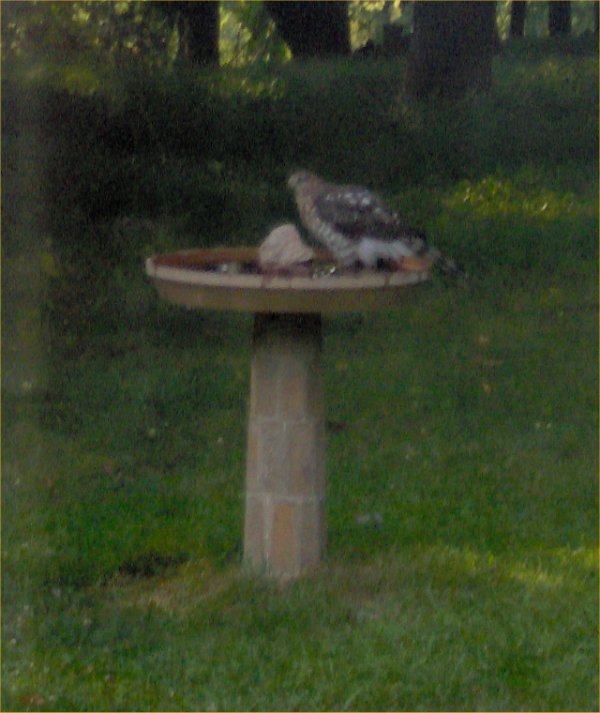
I took this photo on 7/28/08 of a juvenile red-tailed hawk on the bird bath. He/she was taking a
bath (not in the photo but before and after it):
Hawk
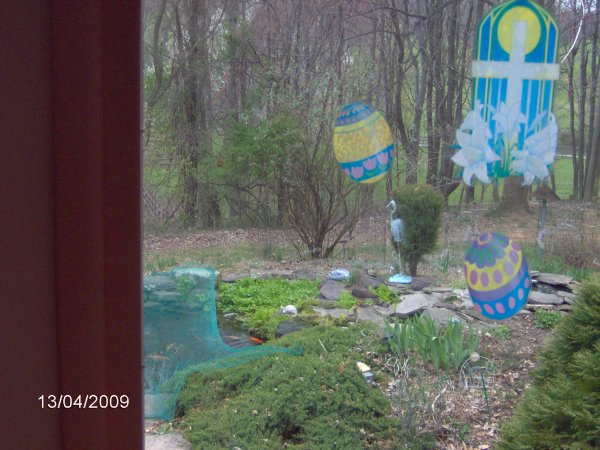
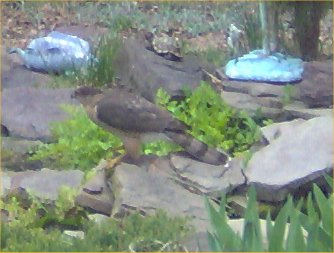
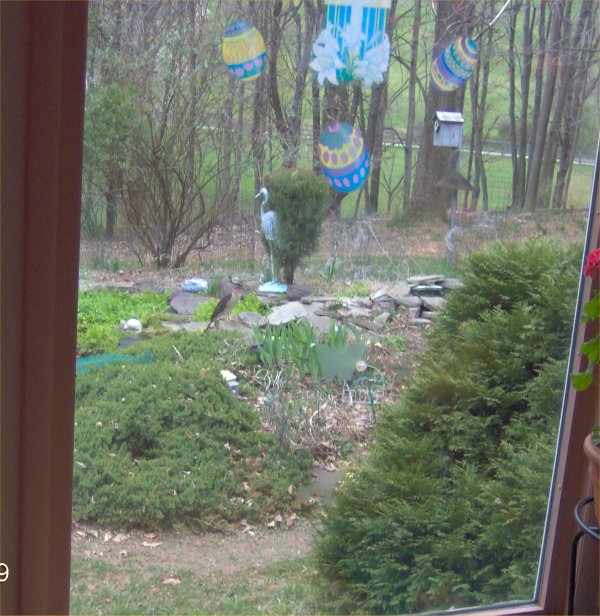
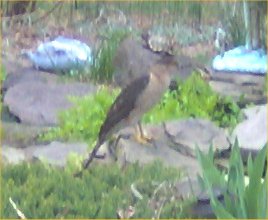
These four photos from 4/13/09 show a Cooper's hawk by my pond:
Cooper's hawk on the waterfall rocks through
the window.
Cooper's hawk - close up of the hawk from the
last photo.
Cooper's hawk on the waterfall rocks through
the window.
Cooper's hawk - close up of the hawk from the
last photo.
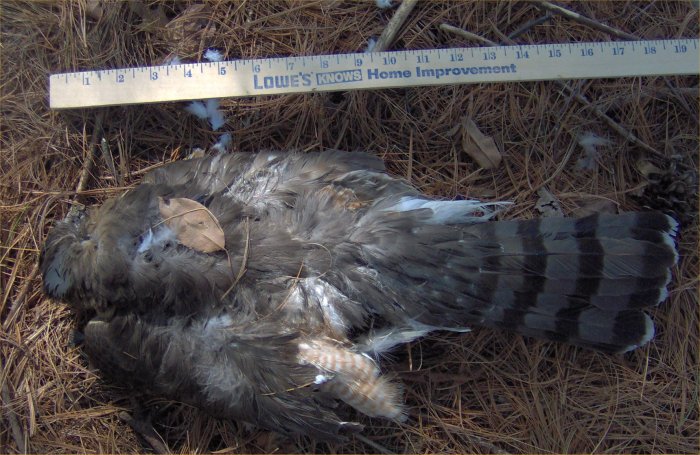
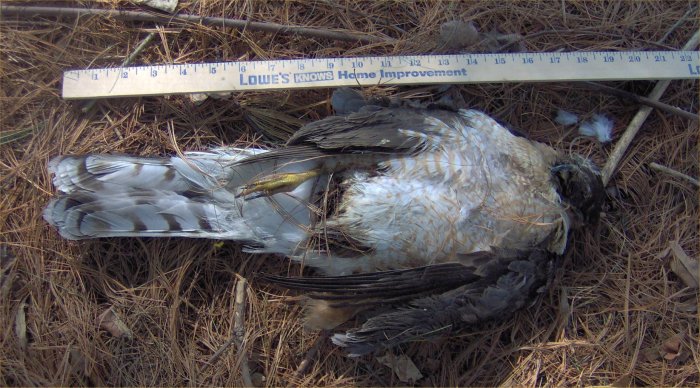
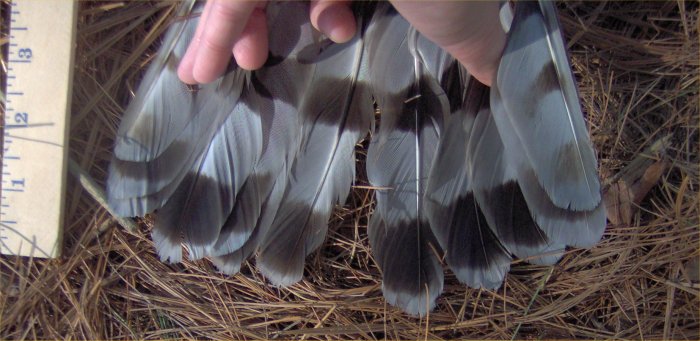
How did I know for sure it was a Cooper's hawk and not a sharp shinned hawk? A few days
later, my mother found a dead hawk that had been dead for a few days (based on level of insects
in it). It was either the same bird or its mate. A bird expert verified that it is a Cooper's hawk.
Here are photos of the dead hawk from 4/26/09 with a ruler for measurement:
Dead Cooper's hawk- top view.
Dead Cooper's hawk- bottom view.
Dead Cooper's hawk- underside of the tail
feathers.
Jim sent this story to me on 6/8/09:
"Reading your hawk stories today reminds me of something that happened at one of my ponds a
few years ago. I had a fat, kinda squatty goldfish like a shubunkin with a fantail. I had it inside
in an aquarium and put him outside, and it grew rather large for my 250 gallon pond . Anyway it
used to swim around near the surface a lot, and one morning I could see it swimming around
near
the surface from inside my house. The pond is about 5 feet from my breakfast room window. I
remembered thinking I wish the fish would go a little lower in the water so it would not be so
easy to spot and get attacked from above . I had seen a hawk near the pond a few weeks earlier,
and it flew off when I drove up in the driveway and flew to my neighbors roof. A few minutes
later, a large bird (hawk) came swooping down and grabbed the fish in its talons. I ran outside
the door and yelled. The hawk dropped the fish on my deck, and I picked it up and threw it right
back into the water like it was a hot potato! The fish quickly swam or sank to the bottom, and I
did not see it for a few days but, eventually, I did, and it lived for a few more years. There was
some blood on the deck but evidently not a fatal attack. I guess I scared the hawk enough to
drop
the fish so it could fly faster? I would guess the hawk was either a Cooper's or sharp-shinned
since that is what I mostly see in the neighborhood, and it is very woodsy."
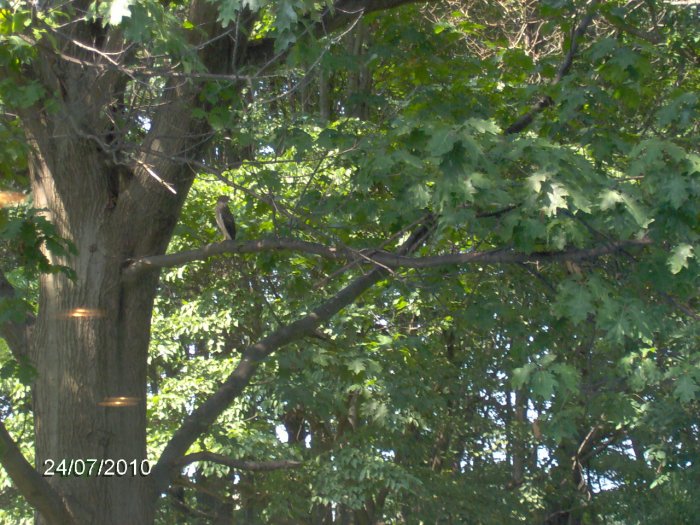
The hawks were making a lot of noise in the front white pine forest in July of 2010. I assumed
they were red-tailed hawks until I started seeing the hawks. I think they are Cooper's hawks
again so it is nice that the surviving hawk found a new mate. Here is a photo of one of the
hawks
that came and sat on the white oak tree above the swimming pool on 7/24/10.
Cooper's hawk from a distance.
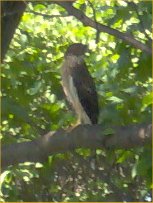
Cooper's hawk - close-up from the last
photo.
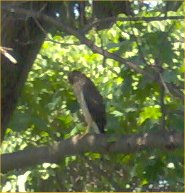
Cooper's hawk - close-up from another
photo.
I was feeding the cats early on 3/26/12 when my eye caught splashing in my 153 gallon pond. I looked out to see a Cooper's hawk fly off with one of my large frogs (either green frog or bullfrog). I ran outside but he/she took the frog with him/her and did not drop it. It is amazing that any frogs survive.
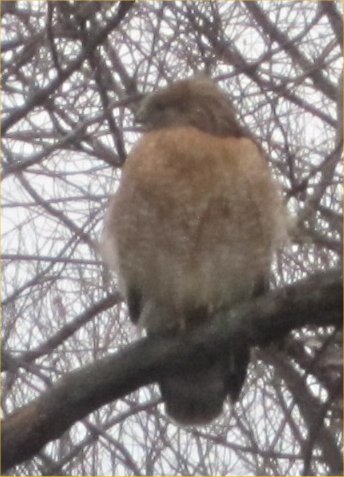
A hawk spent some time looking at my pond fish longingly on 1/18/15 but could not get
them because the pond was netted. He/she is kind of fluffed up as it was cold. Looking at this photo on 6/2/16, it does not
look like a red-tailed hawk like I said it was when I posted it. The beak is very short. Could this be a red-shouldered hawk? What
do you think?
Hawk
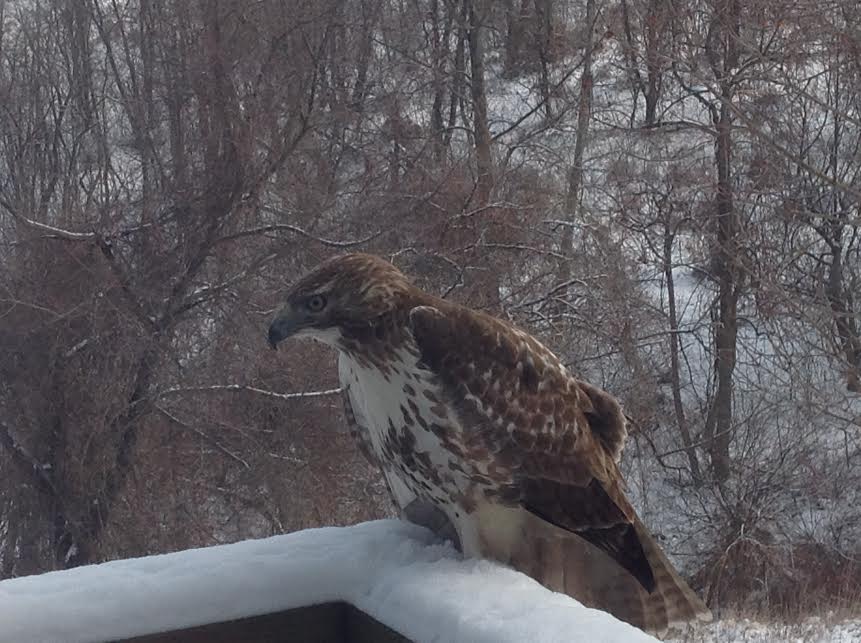
My niece took this photos of a red-tailed hawk on her deck with snow on 1/27/15:
Red-tailed hawk
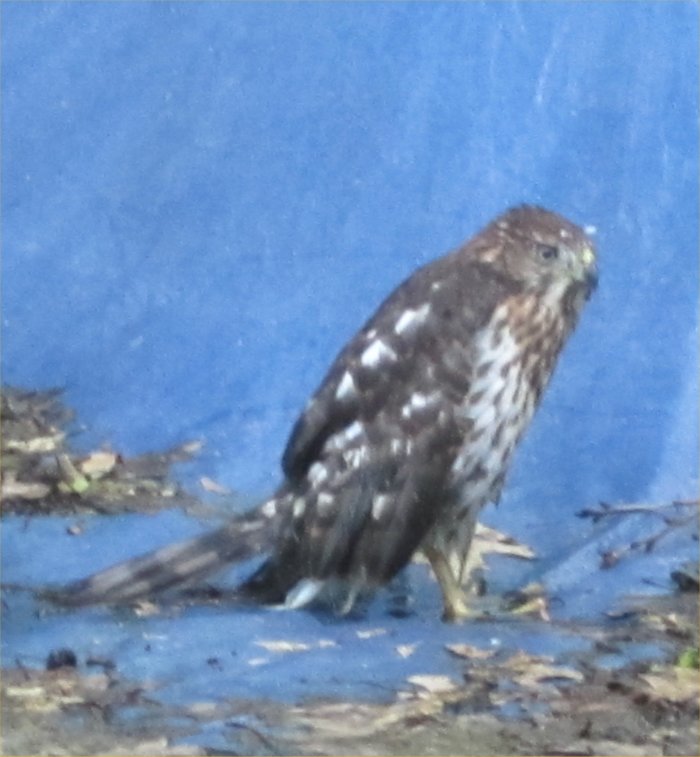
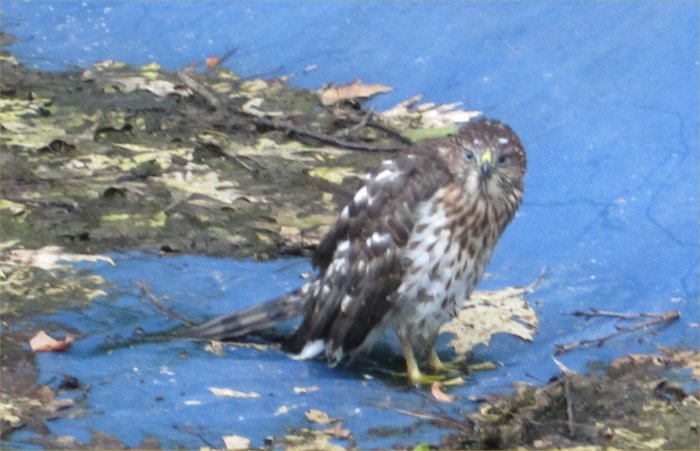
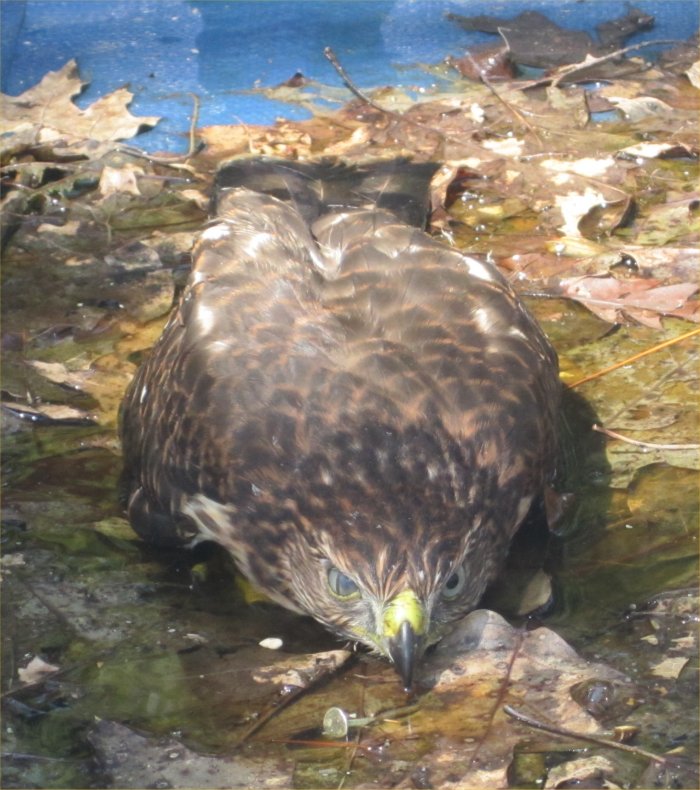
On 7/18/15, there was a Cooper's hawk sitting on the pool cover (the pool was not opened in 2015 due to a
leak so the cover was down low, and the hawk was stuck). The hawk was too weak to walk up the steep sides of
the cover, and it could not fly. I called a rescue to come get him/her. When I checked later, they said they "had to
euthanize" and that the hawk was full of maggots.
Sick Cooper's hawk - right side, standing up
Sick Cooper's hawk - right side, standing up
Sick Cooper's hawk - front view, laying down
While not technically birds of prey, kingfishers are meat eaters and will eat pond fish and amphibians.
Kingfishers are smaller birds that may go unnoticed except for their load call which is hard to forget. I saw some kingfishers at a local reserve and saw and heard them in action. They will dive bomb into ponds from above, grabbing small fish with their beaks. Only a net can really keep them out.
Ospreys live to fish. Even more so than eagles, the smaller ospreys are adept at catching fish by diving from above and grabbing fish with their talons. As with the other dive-bombing birds, netting will keep them out. Ospreys are larger than kingfishers but smaller than eagles and the larger hawks. I have never seen an osprey in the wild.
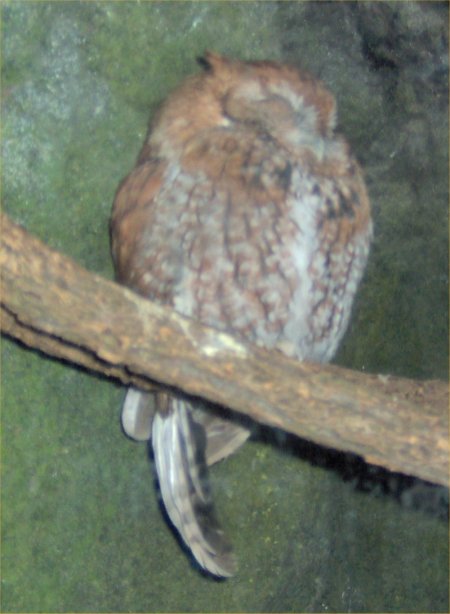
I have never seen an owl on our property in 30 years. We suspect the following exist on our land but we never see them: screech, great horned, and barn owls.
By August 2002, I had heard of owls taking fish and frogs from ponds. Owls are nocturnal and secretive. Yet, two pond keepers have related stories to me (8/02) of owls dining at their ponds. One owl was eating fish. Another ( a barred owl) was suspected (but not proven) of dismembering frogs. As with the other birds on this page, they hunt from above. Thus, aside from netting and plenty of places for fish to hide, there is not much to do to prevent attacks if they occur.
See my June 2004 Pond Newsletter for an owl-eating-pond-fish story.
I think I heard an owl for the first time on our land one night in February, 2007. It sounded almost fake, "Who, who."
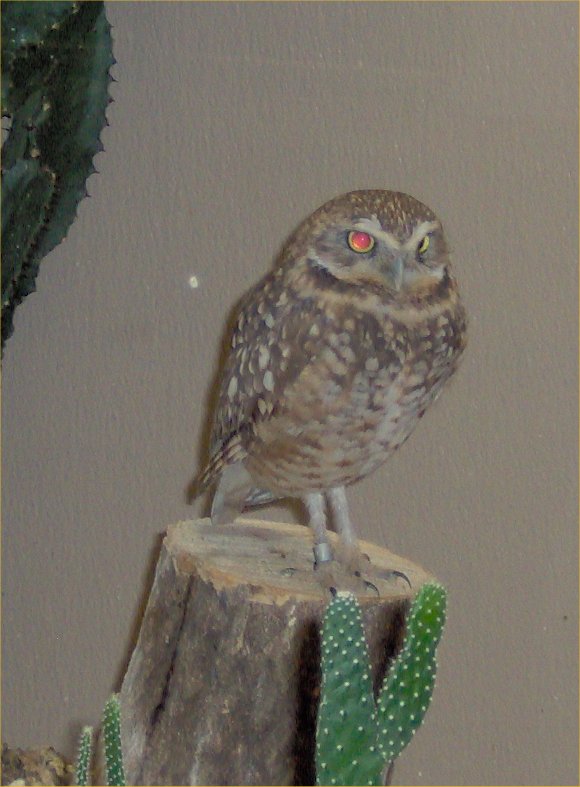
I took this photo at the National
Zoo on 9/14/07:
Burrowing owl
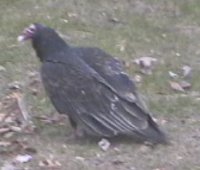
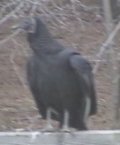
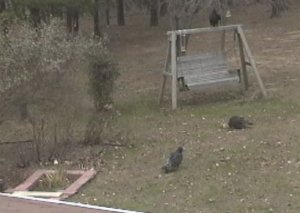
On the left is a turkey vulture, and on the right, is a black vulture, taken 1/6/02. Here is a photo taken at the same time of three vultures: Vultures near the pond on 1/6/02. On the ground are two turkey vultures. On the swing is a black vulture. The 153 gallon pond is to the left of the picture.
Shortly after we moved into our house in the late 70's, they put in the county landfill near us. We soon had hundreds of vultures living and breeding near us. On warm days, a cloud of them would fly over. Most of the landfill was closed by 2001 so now there are fewer. On this day, 1/6/02, my mother had put out a turkey carcass (actually a boned breast bought at the grocery). The vultures soon came down to pick it clean. For more information, see the February 2002 pond newsletter under interesting animal sightings.
Vultures do not hunt live prey so should not bother with anyone's ponds. They eat carrion which is dead animals. They prefer to wait for the animal to be dead about a day before eating it. Vultures are skittish and will noisily flap off if they feel threatened. Because they have no need to sneak up on prey, their feathers make a lot of noise when they fly. On the other hand, when they are gliding, there is no noise. Vultures love to glide on the air currents, looking and smelling for anything down below.
When scared, a vulture may regurgitate its stomach contents onto a would-be predator. When we were kids, my neighbor was standing under a tree with a vulture who dumped fecal matter on his head. While many of us think vultures are "yucky," they are nature's garbage collectors. Without them, there would be a lot of rotting corpses around (at least until the maggots finished them off).
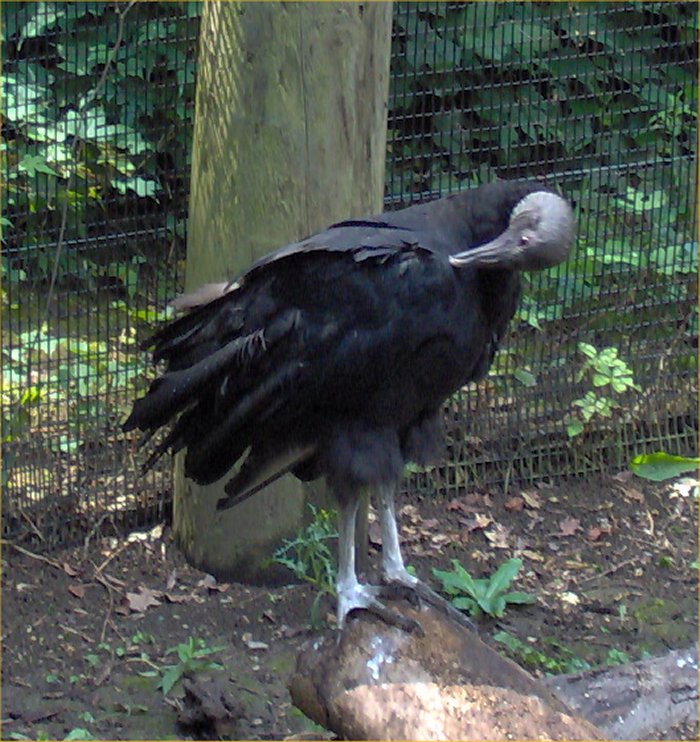
Black vulture preening itself at the Maryland Zoo on 8/19/10.
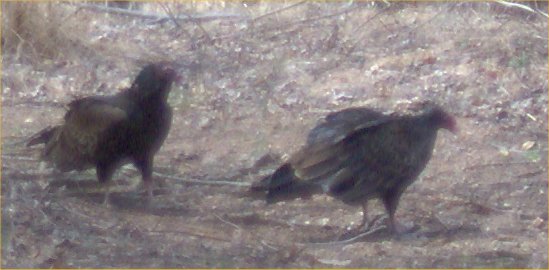
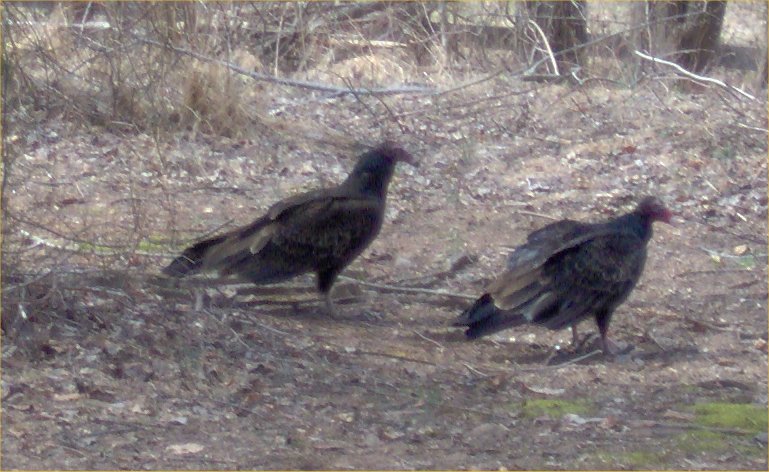
On 3/29/13, I put out a dead goldfish by my pond which I have done many times but, this time,
two turkey vultures came down and ate the fish!
Two turkey vultures
Two turkey vultures
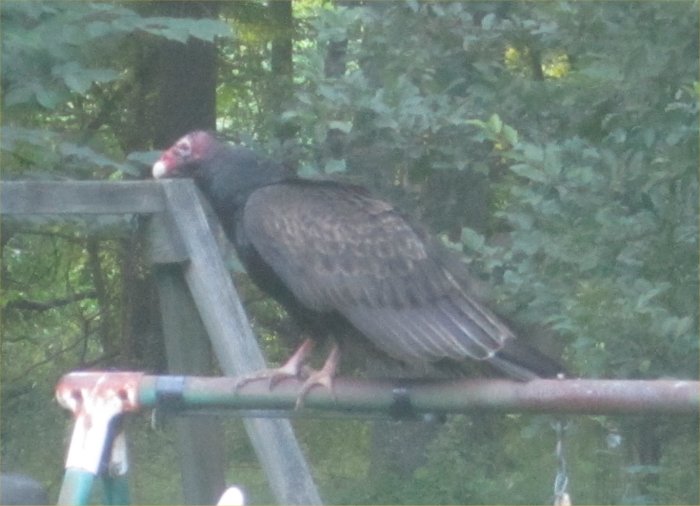
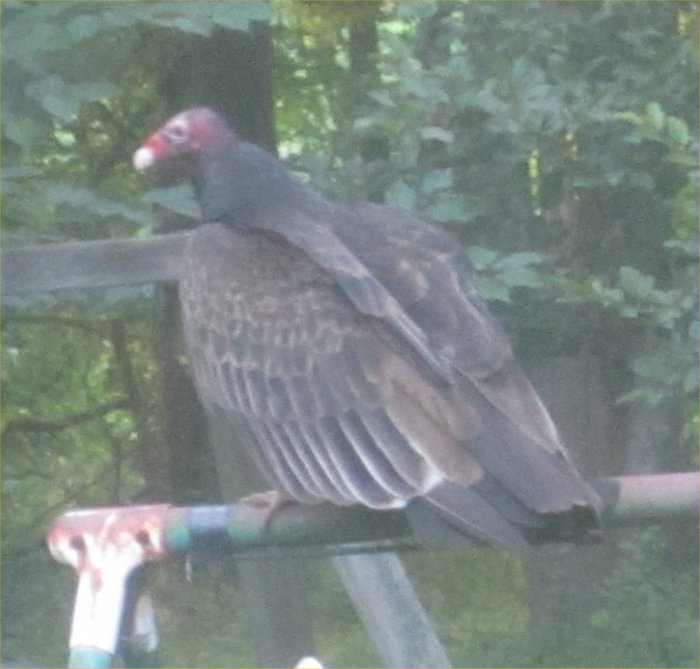
On 6/6/17, I took these photos of a turkey vulture hanging out in the back yard on the swing set.
Turkey vulture
Turkey vulture
|
|

|

|
E-mail RobynCopyright © 1997-2026 Robyn Rhudy |

|
 |