|
|
 |
 |
 |
 |
 |
 |
 |
 |
 |
 |
 |
 |
 |
 |
 |
Last Updated: 5/11/23
Sirens, Mudpuppies, and Hellbenders
Amphiuma
Axolotls
Eastern Newts or Red-Spotted Newts
Dusky Salamanders
Long-Tailed Salamanders
Mud Salamanders
Red-backed Salamanders
Red Salamanders
Spotted Salamanders
Tiger Salamanders
Two-Lined Salamanders
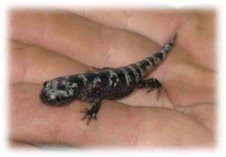
Sirens (Siren species), mudpuppies or water dogs (Necturus maculosus), and hellbenders (Cryptobranchus alleganiensis) are three species of salamander that spend all of their lives in the water. They grow one to two feet long and eat fish, crayfish, insects, and whatever else they can get. They are "ugly" to blend in with their habitat so prey cannot see them. Due to their size, eating habits, and varying rarity in the wild, they are not species you would intentionally add to your pond but they could show up if you have wild waters that enter your pond, etc. A bird could also drop their eggs in your pond. It is weird how things show up that seemingly have no way of getting there. These aquatic species of salamander are often sold as pets for aquariums.
The mudpuppy, Necturus maculosus, grows to 17" and is larger and ranges from southern Canada to the southeastern US. A few subspecies in the southern US include the 8" Gulf Coast waterdog and the 6" dwarf waterdog. All of these aquatic salamanders will eat live worms, insects, fish, and sometimes trout chow and crayfish. They are nocturnal. The mudpuppy female lays 30-190 eggs between April and June under stones or logs. They hatch in a few months. After about five years, they are ready to breed.
The hellbender, Cryptobranchus alleganiensis, grows to one or two feet! They breed in the fall when a female will lay 200 to 500 yellowish eggs in a male's nest. The male guards the eggs until they hatch in 2 to 3 months. They eat worms, snails, insects, and crayfish. In captivity, they may live up to 30 years.
The greater siren, Siren lacertina, grows from almost two feet to over three feet long! It breeds in the early spring and is only found in the coastal areas of the southeastern US. The lesser siren, Siren intermedia, only grows to from half a foot to a little over two feet. In the spring, females lay a few hundred eggs in a nest. It makes noises when disturbed. Unlike the other related salamanders, the lesser siren will eat some plant material as well as insects, etc. The dwarf siren, Pseudobranchus striatus is smaller at about half a foot. They live almost exclusively in Florida.
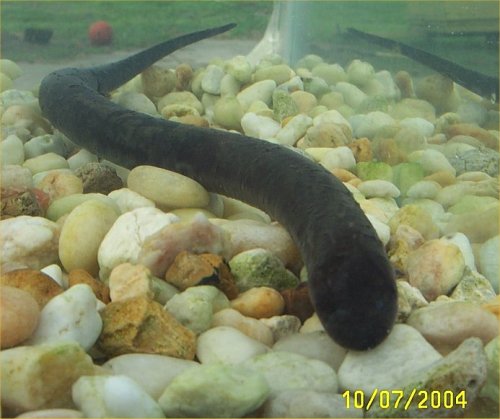
On 10/7/04, Petrea sent me this photo of an animal that they had found following the many hurricanes that Florida had the weeks before. It had washed up. At first, I thought it was a siren but then, seeing the photo, the legs were just too tiny. We decided it was an amphiuma which I had never heard of before (see, I'm no expert!). The two-toed amphiuma, Amphiuma means grows 1.5 to almost 4 feet long! The three-toed amphiuma, Amphiuma tridactylum grows 1.5 to 3.5 feet long. Amphiumas are nocturnal, aquatic, long lived, and apparently nasty. Most are in Florida but also in some other Southern swamp-type habitats. Here is the enature.com pages on the two-toed amphiuma and the three-toed amphiuma.
Petrea replied to me, "I just looked up amphiuma and I feel very strongly that that is exactly what it was! Thank you so much! You Rock! Thanks for all your help, it is quite unusual for us to have found something that we hadn't ever seen before!." They kept the injured salamander for a few days but it died of its injuries from the hurricane.
The axotyl or axolotl, Ambystomaa mexicanum, is a similar species that lives in Mexico, a close relative to the tiger salamander (Ambystoma tigrinum) with which it can interbreed. It only exists in the wild at the Xochimilco lake in Mexico. The axolotl is neotonic which means that it almost always remains in the aquatic form, retaining gills. They are sometimes also called water dogs as are the mudpuppies. It is a common pet salamander and as such, has been bred into albino, yellow, black, and other colored forms. They grow to 8 to 12 inches, live into their teens, and eat insect larvae, small fish, worms, etc.
Links:
Axolotl Colony - formerly at Indiana University and now in Kentucky
I had this link request for VCI which sells adult axolotls.
Axolotls
The Eastern newt's scientific name is Notophthalmus viridescens. It spends two stages of its life in the water. The newt is born in the water, turns into an eft and lives on land, and then returns to spend the rest of its life in water as it breeds. It grow 3 to 5 inches long and eats small animals. Efts are red while adults are a mix or greens, yellows, and reds. Females lay a few hundred eggs in the spring among aquatic plants. In one to two months, the eggs hatch. By the fall, the newts leave the water as efts or skip that step and become aquatic adults. They eat worms, insects, fish and amphibian eggs and larvae, and crustaceans. Newts secrete toxins that make them unpalatable to fish.
I bought and added three adult Eastern newts to my pond in 1998 and have not seen them since. One of my female green frogs was eyeing them with interest.
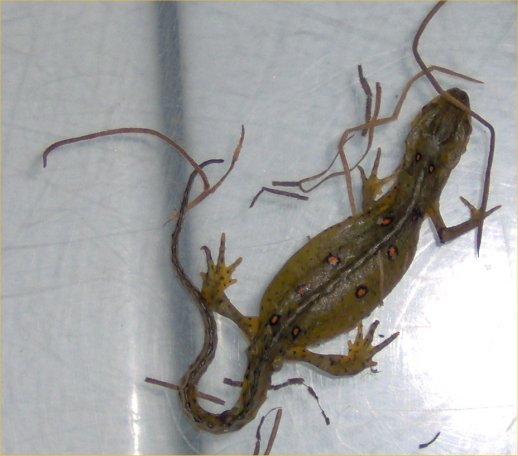
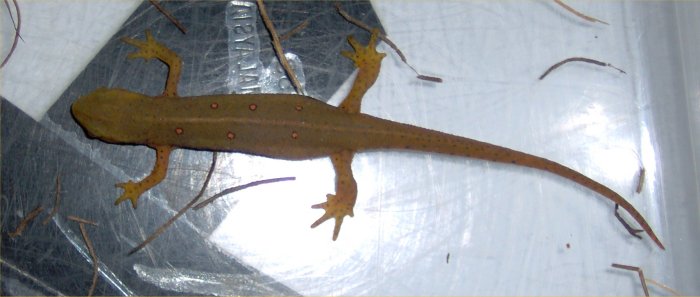
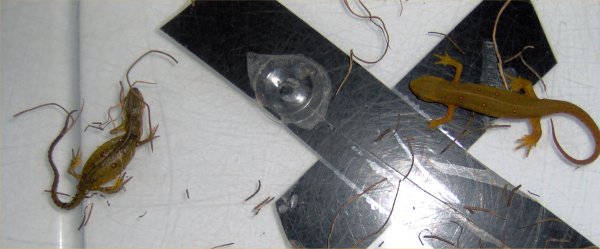
On 5/25/09, I got two adult Eastern newts that I put in my 153 gallon pond. Something was
seriously wrong with one of them. I do not know if it was emaciated, dehydrated, infested with
parasites, or perhaps had some disease. The other one was fine, and I saw him a few days later.
Time will tell if I see that one again (no sightings as of 6/29/10). I doubt the sick one survived
but it was alive in the photos (hard to believe). They packed the newts in dry fibers with no
water source!
Sick newt
Healthy newt
Both newts
Three Eastern newts at the Washington, D.C. zoo on 10/2/11.
I was shocked to find a salamander in my pond on 3/14/12 when I cleaned out the
153 gallon pond! I
did not see her in 2010 or 2011 when I cleaned the pond so she must have been wandering in and
out of
the pond. I was not sure this animal was the one I had put in there until I examined the photos
more.
While Eastern newts have red spots on their green back, this girl had a solid brown back.
However, due
to her belly pattern and paddle tail, I determined her to be the Eastern newt. The brown back
may have been
due to the temperature, stress, etc. The newt either was full
of eggs or had bloating or an internal infection (worms, bacteria, etc.). I prefer to think that she
was full of eggs. Unfortunately, she has no mate. I put her in the 50 gallon tub pond fearing that
she
would be eaten by all the frogs. I will have to clean that pond in the fall to look for her (and
move her
to the 153 gallon pond if I find her). Here she is!
Video of the Eastern
newt
Eastern newt - top view in
bowl
Eastern newt - side view in
hand
Eastern newt - top view in
bowl
Eastern newt - top view in
hand
Eastern newt - top view in
hand
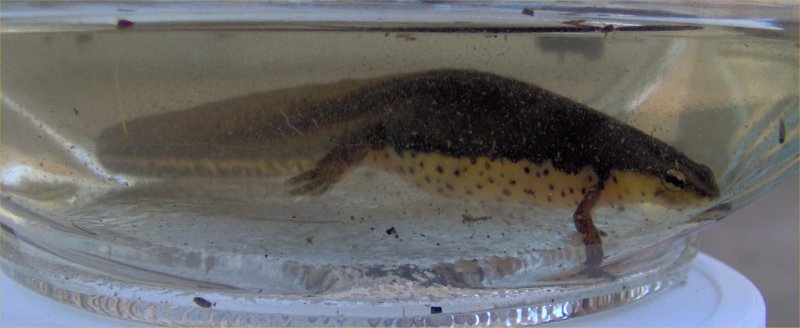
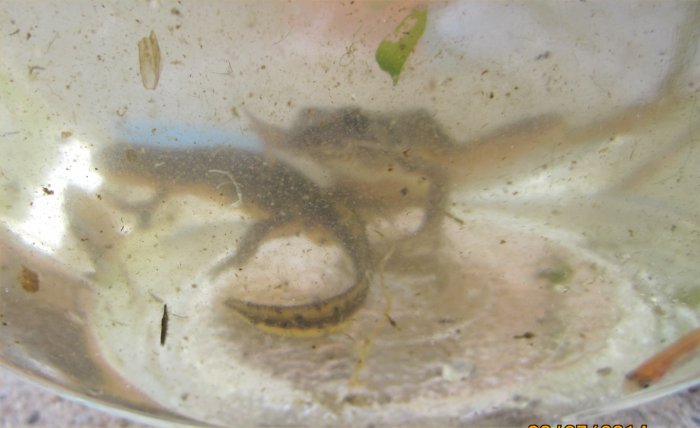
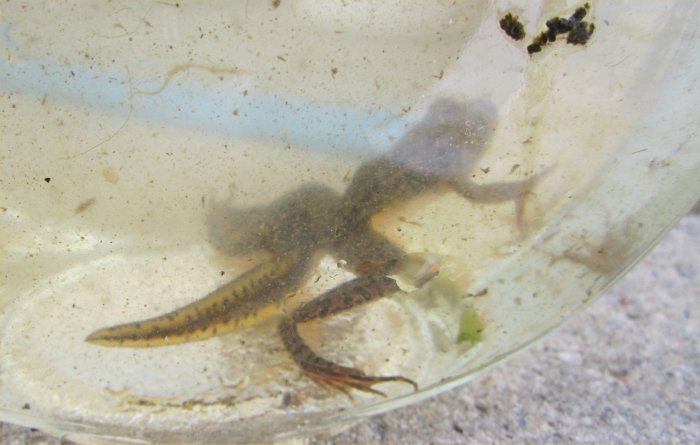
Eastern newt - side view in glass
bowl; this is a GOOD photo!
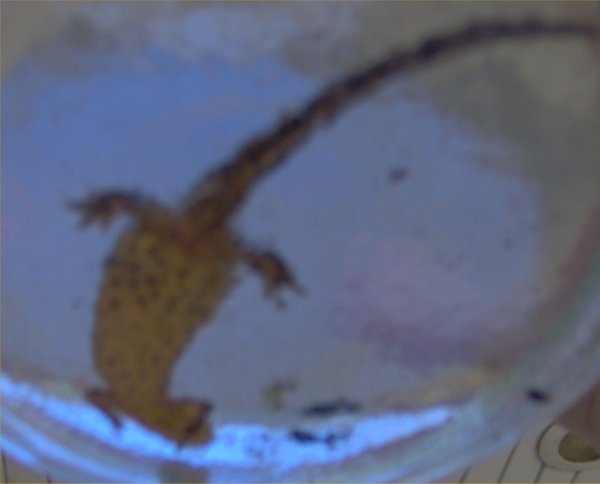
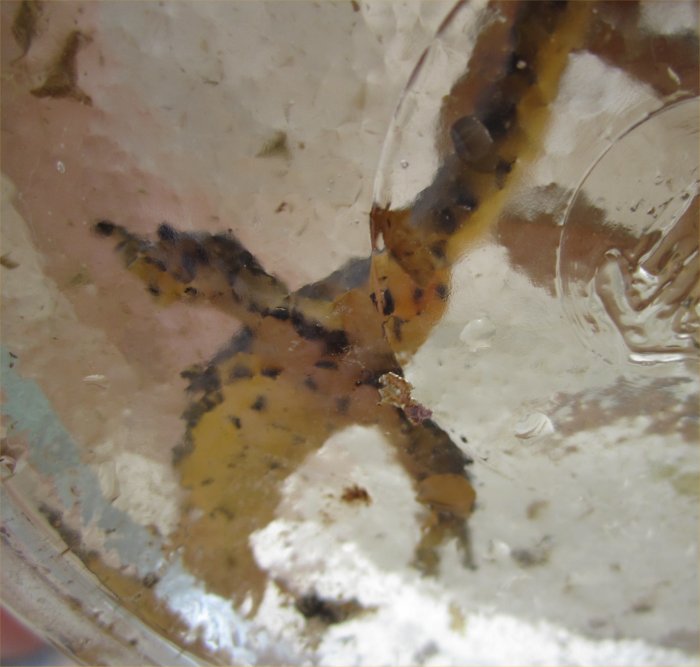
Eastern newt - view of stomach
looking up through glass bowl
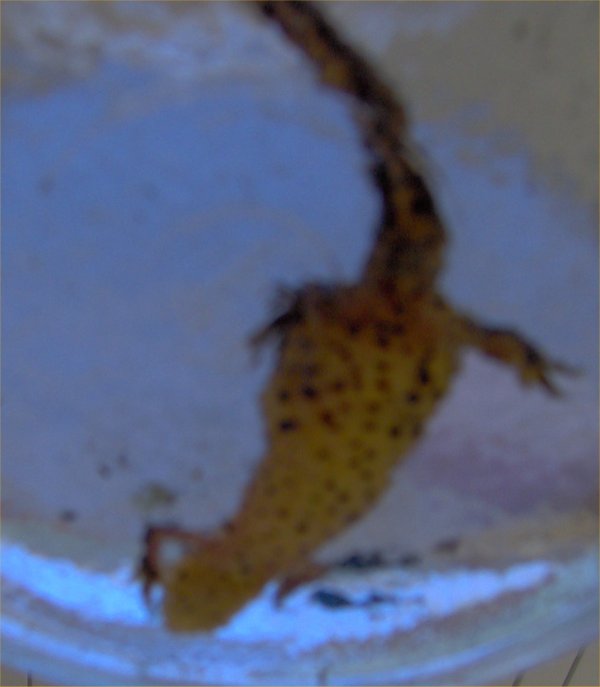
Eastern newt - another view of
stomach
Eastern newt - top view in glass
bowl
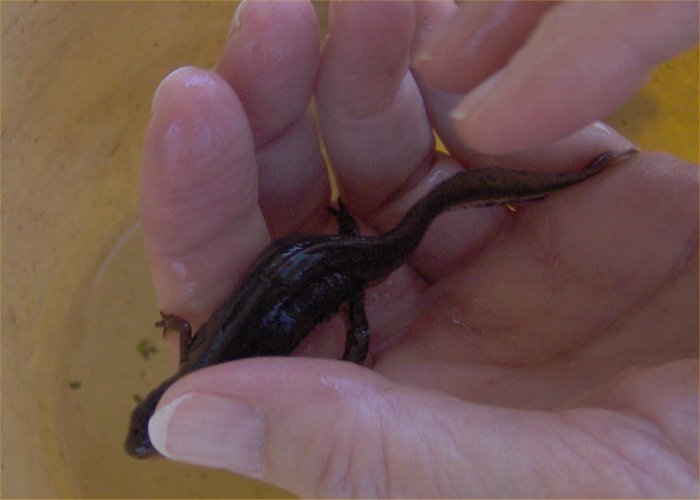
All of these photos were taken on 3/30/13 when I cleaned out the 153 gallon pond and found the
same Eastern newt again. I am sorry that many of these photos are fuzzy.
Eastern newt in kiddie pool
Eastern newt in kiddie pool
Eastern newt in my wet hand
Eastern newt in my hand
Eastern newt in my hand
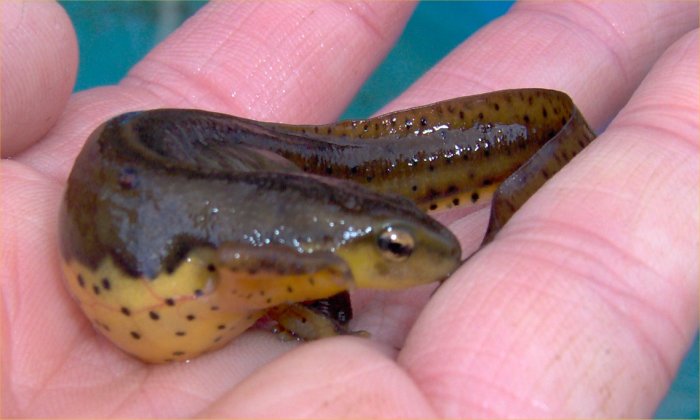
Eastern newt in my hand, nice
photo
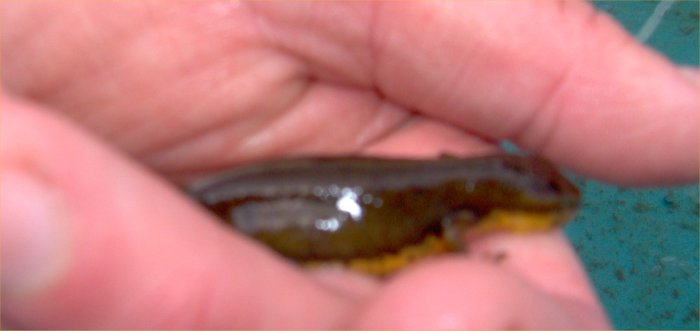
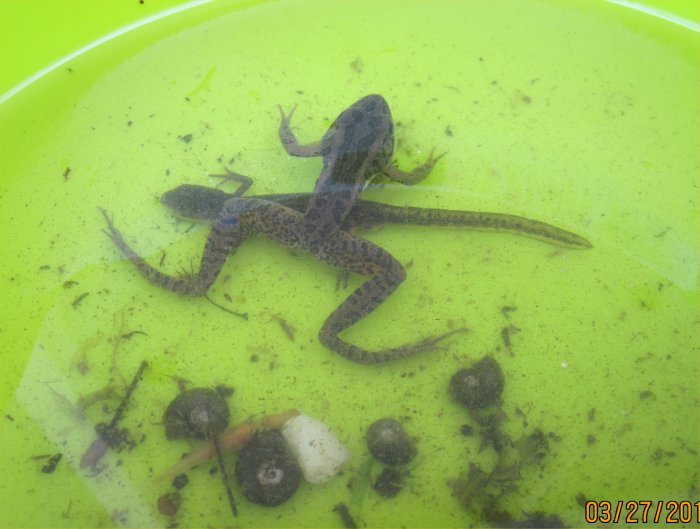
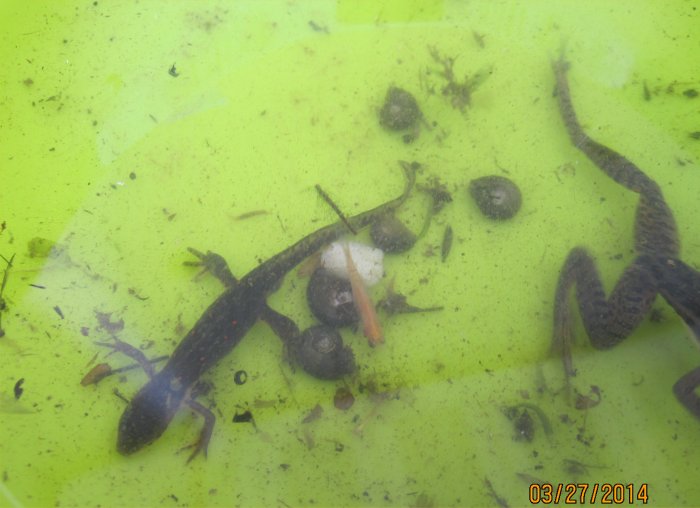
All of these photos were taken on 3/27/14 when I cleaned out the 153 gallon pond and found my
Eastern newt in it. She has now been in there for five years!
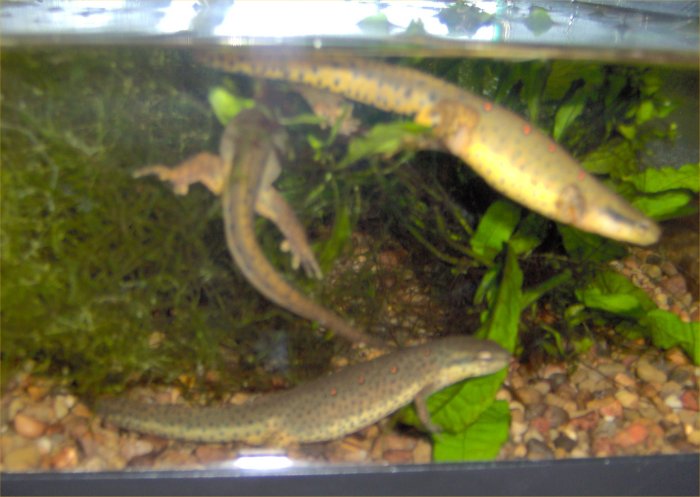
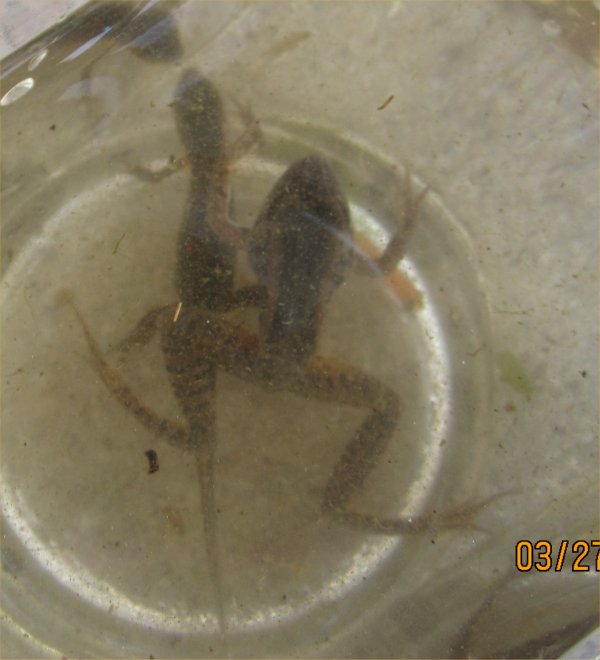
Newt, pickerel frog, rosy red minnows, and snails
Newt, pickerel frog, rosy red minnow, and snails
Newt and frog
Newt's belly
Newt and pickerel frog - side view; it looks like the
frog has a long tail but that is the tail of the newt
Newt and pickerel frog - view from above
Alas, when I cleaned out the 153 gallon pond on 4/8/15, I did not find the newt this year. While it is possible that he/she is in another pond, I fear the worst.
The dusky salamander, or Desmognathus fuscus, is brownish and lives in the Eastern United States. Growing from 3 to 5 inches long, it must stay near water. Unlike most land salamanders, it lacks lungs and breathes through its skin so it must stay wet. Females lay a few dozen eggs in summer near water (not in it). The larvae hatch in 2 to 3 months and turn into adults in 6 to 12 months.
On 3/2/10, Sherri sent this photo of a salamander that may be a dusky salamader.
Dusky salamander
I added this entry on 10/9/17 because the day before, I saw a salamander that I think was this species! I was cleaning the pond, and when I went to move the rock to open the drain for the biofilter, I saw a salamander! It was orange-yellow with black spots and about three inches long! By the time my brain registered what I was looking at, it was gone. While it is possible it was a differently colored eft (red spotted newt) or two-lined salamander (I saw no line, and that species does not get as big as what I saw), it actually looked most like the long-tailed salamander (Eurycea longicauda longicauda. This is a new species sighting for me! It is too bad he/she didn't wait for a photo because you probably do not believe me.
Pseudotriton montanus is the mud salamander. It lives in cool, wet mud and grows 3 to 7 inches long. It has brown speckles over a red or orange body. Females lay 100 to 200 eggs in the winter that hatch in late winter. It takes a few years for them to turn into adults.
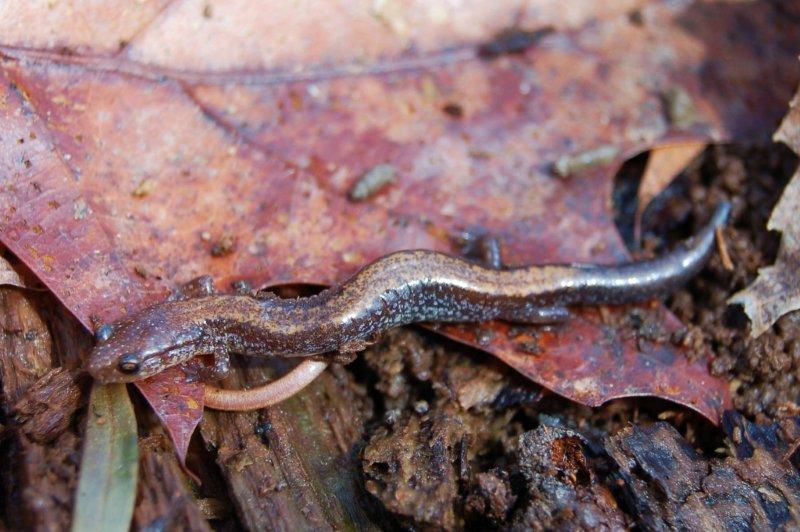
The red-backed salamander, or Plethodon cinereus, lives in moist places and grows to 4 inches. It has a red stripe down its back and is black elsewhere.
Pseudotriton ruber is the red salamander. It grows from 4 to 8 inches long. Like the mud salamander, it is red with black flecks. Females lay 50 to 100 eggs in the fall. Larvae turn into adults after a few years. They prefer to live around leaf litter near natural springs and damp woodlands.
Ambystoma maculatum, or the spotted salamander, is the only salamander species with which I have experience. I bought a few egg masses in early 1998 which hatched. All but five larvae went into my ponds to live. Five were raised to adulthood. They lost their gills and changed from brown to black with yellow splotches. They ate baby brine shrimp and cut-up black worms like little vacuum cleaners. I released the remaining five in May, 1998.
Most of the time, spotted salamanders are half a foot underground or under moist humus or leaves. Adults can grow to 6 to 9 inches long and live 20 years. They feed on whatever comes their way that is small enough and slow enough to catch. Adults have a mass migration to breeding pools in late winter. Females lay a round ball of about 100 eggs in the winter. They hatch in a month or two and turn into adults after another 2 to 4 months. Many spotted salamanders have died out because acid rain has killed off the eggs.
I got some more spotted salamander eggs in March of 2001 that began to hatch by early April. In April, I put many in my 50 gallon lotus pond because it was my largest fish-less pond. All the salamanders were outside by 4/14/01. By 6/5/01, the larvae, now larger, could still be seen in the 50 gallon pond occasionally coming up for air. I fed them blackworms.
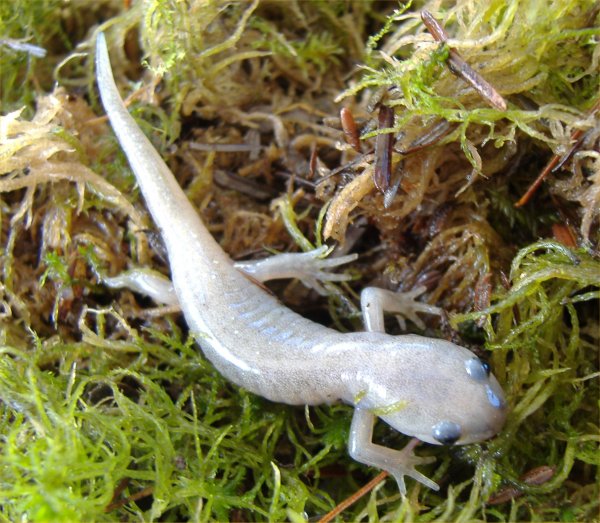
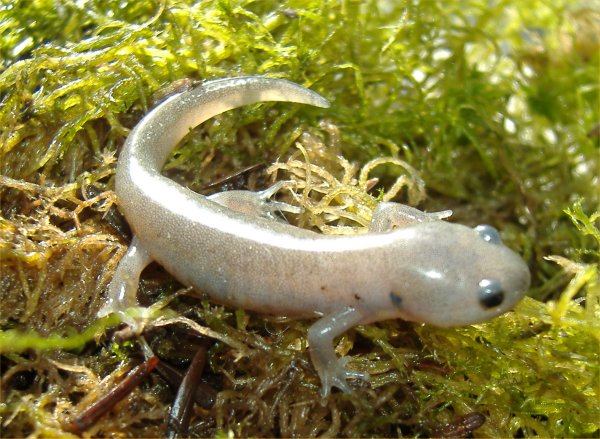
On 9/16/07, Jon sent three photos of his baby leucistic (similar to albino but not exactly the
same) spotted salamander.
Baby leucistic spotted
salamander
Baby leucistic spotted
salamander
Baby leucistic spotted
salamander
I got the shock of my life on 4/1/19 when I was cleaning out my 153 gallon pond and looked down to see a huge, maybe 6" spotted salamander! Once I got a bunch of photos (not processed) and got over the shock, I realized that the four hazy egg masses in the pond were from her (or him but the other parent(s) was/were gone). I am assuming that this huge salamander was born in 2001 when I put in those eggs making her 18 years old! Is it possible that this salamander was 100% wild and not because of something I did, sure but I do not think it is likely. Now, I need to buy expensive live blackworms to feed the larvae because the pond had no visible insects, insect larvae, or worms (and I would know because I hand sorted every bit of the pond to do the 100% cleaning and have saved insects and worms in past years).
I found a huge adult spotted salamander in my 153 gallon pond when I cleaned it out on 3/22/21. This time, the salamander was alone, and there were no eggs.
When I cleaned the 153 gallon pond on 3/25/22, that lone huge adult spotted salamander was in the pond again, with no mate and no eggs.
Ambystoma tigrinum, the tiger salamander, is a rather large salamander that spends most of its life underground. It is an orangey-red with black spots. It can grow from about 6 inches to a foot long. It is the world's largest land-dwelling salamander. Eggs are laid in the spring. By summer, the larvae leave the water. Tiger salamanders eat earthworms, insects, frogs, and even mice!
A related species, the axolotl can interbreed with the tiger salamander. See above for more information.
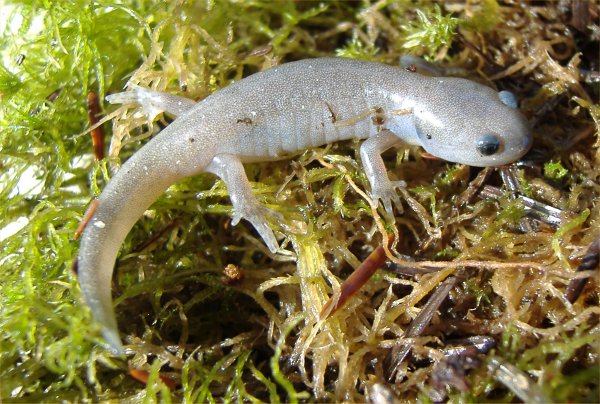
The two-lined salamander, Eurycea bislineata, hides in wet spots during the day and comes out at night to eat insects, worms, etc. like most salamanders. It has two black lines down its yellow back and only grows to about 2.5 to 4.75 inches. Females lay and may guard 12- 100 eggs under plants, logs, etc. It may be one to three years before the larvae leave the water. Some may never turn into adults.
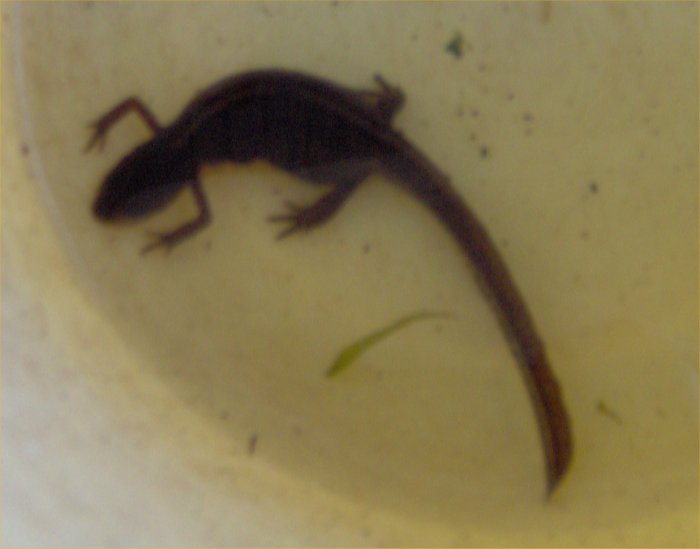
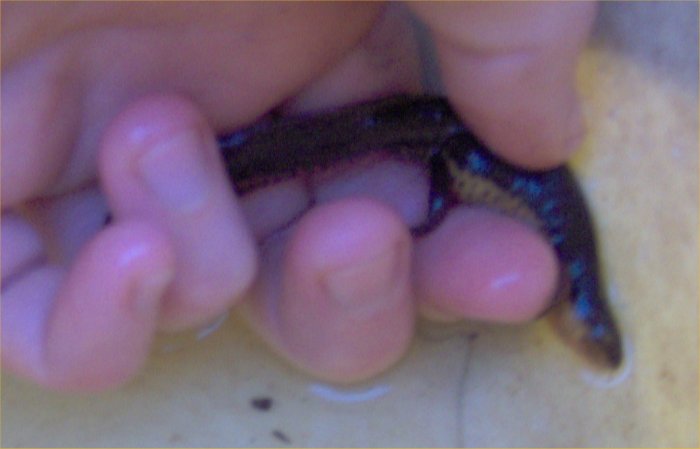
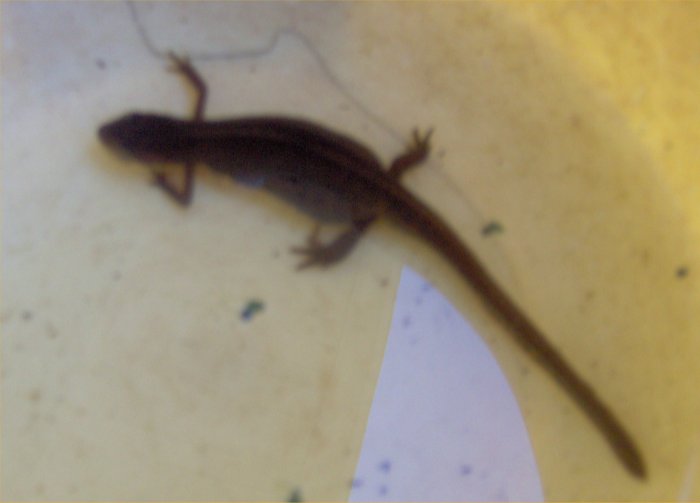
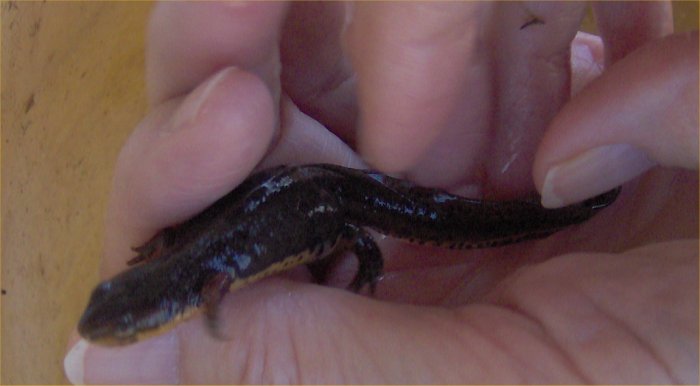
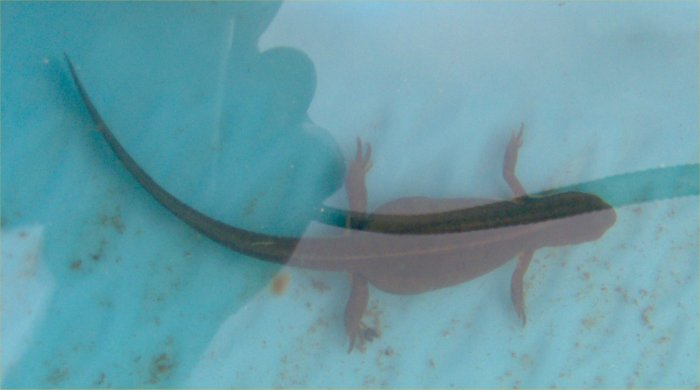
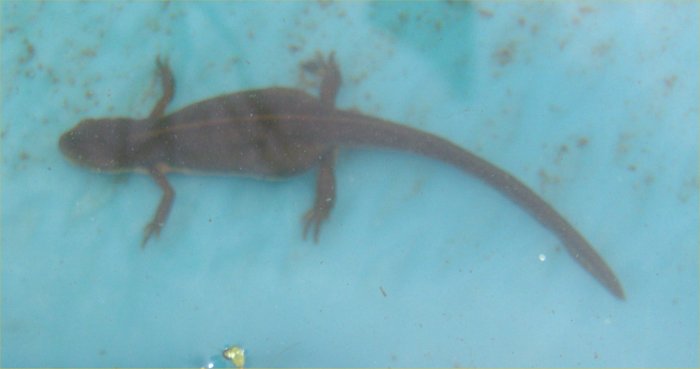
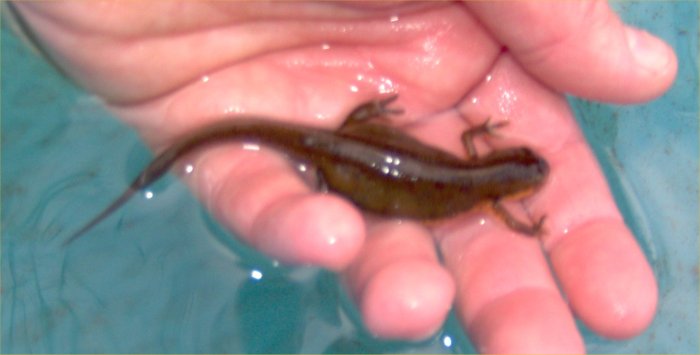
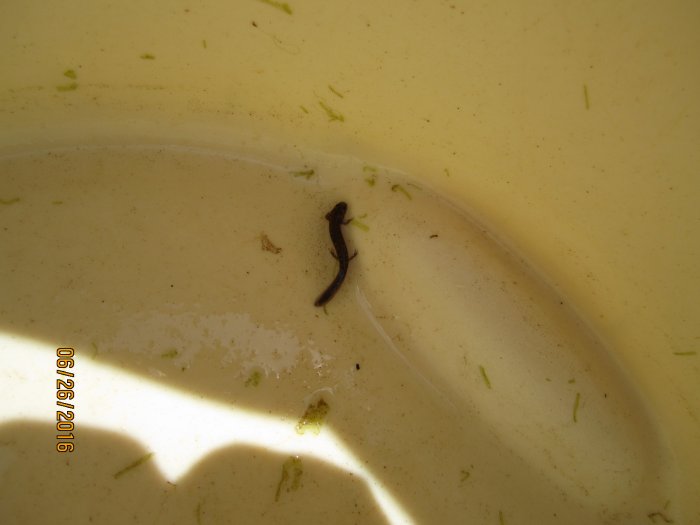
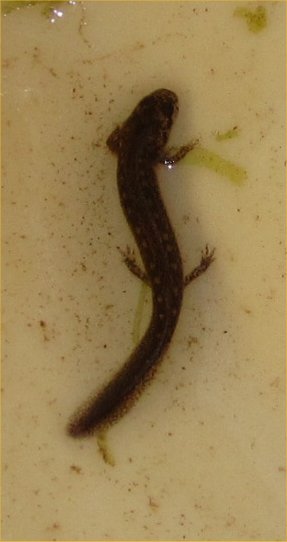
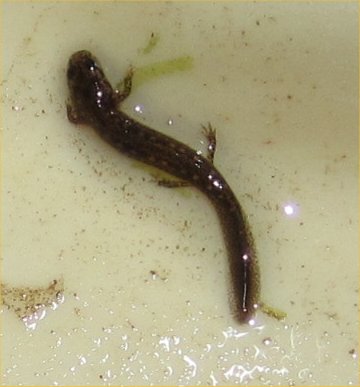
In 2016, I started finding a small, brown salamander in my biofilter during cleaning, maybe three inches long. I
never could get a photo. Then, on 6/26/16, I dumped some algae from my pond and saw something wiggle. I plucked
out this tiny, tiny adult salamander and took photos. It had no gills so it was an adult. I thought it was a dusky
salamander until 1/15/18 when an expert said that photos I sent of another adult was a Northern two-lined salamander
so it is likely that this one was as well. The photo files still say "dusky" so they are wrong.
Two-lined salamander in bucket (to show size).
Two-lined salamander in water.
Two-lined salamander out of water.
Guess what?! On 2/24/19, I lifted up a rock on the waterfall stream (not sure why), and at least two two-lined salamanders dashed away! I lifted up a few other rocks and saw at least two more! They were so fast, so small, so snake-like! They must be at my pond to breed! I was so happy!
On 3/31/19, while scraping algae off of the waterfall, I suddenly had a two-lined salamander in my aquaglove-covered hands! He/she tried to wiggle in to the main pond but I put him/her in the waterfall area lest a fish try to eat him/her!
I cleaned out the 153 gallon pond on 4/1/19, and there was one two-lined salamander in there!
There was one in with the filter floss around the main pump on 3/15/20. They are now breeding in my pond regularly.
When I cleaned out my 153 gallon pond on 3/30/20, I found three salamanders with gills. These were probably two-lined salamander larvae!
When I cleaned out my 153 gallon pond on 3/25/22, I found 20 salamander larave! These were probably two-lined salamander larvae!
When I cleaned out my 153 gallon pond on 3/26/23, I found 5 salamander larave! These were probably two-lined salamander larvae!

|
|
Return to the main amphibian page.
See the master index for the amphibian pages.

|

|
E-mail RobynCopyright © 1997-2026 Robyn Rhudy |

|
 |