|
|
 |
 |
 |
 |
 |
 |
 |
 |
 |
 |
 |
 |
 |
 |
 |
Last Updated: 10/23/19
Introduction and Feeder Roaches
Animals that Eat Roaches
Roach Setups
Feeding and Watering
Breeding
Maintenance
My Roaches
Photos of My Roaches
Books and Links
This page is for information on keeping roaches to feed to other animals or as pets themselves. I do not cover those who wish to kill off roaches that have invaded their homes. The roaches of which I speak are tropical species, most of whom cannot fly, jump, or climb well. These species are not "pests." They do not carry diseases. They do not normally bite. They do not make any noise (except as a result of moving around) with the exception of hissing cockroaches. They stink a lot less than crickets and do not die off as easily (my crickets get some sort of fly parasites that eat them).
Most tropical roaches need heat, like to be in the dark, and will live 1 to 2 years once they are adults. The babies, or nymphs, already have the roach shape when born (no pupae phase) but their coloration often changes with each molt as they grow.
The following are some of the animals that will eat big roaches.
Reptiles:
Large aquatic turtles like snapping turtles, large tortoises, sailfin lizards, basilisks, water dragons, and other huge
lizards.
Smaller roaches are also eaten by all the animals that I list that eat crickets on my cricket page.
Tropical roaches need heat. I have an undertank heater and a fixture with a 60 W ceramic heat emitter over my 20 gallon glass aquarium with roaches. The warmer the roaches are, the more they will reproduce. They like it hot. I am not sure at what temperature they will start to die. Most roaches like it in the 80's at least somewhere in their setup.
Roaches can be kept in aquariums, storage tubs, plastic buckets, etc. There should be ventilation but they should not be able to escape. Some people keep them with a substrate such as reptile bark or reptile bedding with Eucalyptus leaves or aspen. Others do not use a substrate. Put in paper towel and toilet paper rolls and egg crates for them to spread out and hide in.
Foods that I offer my roaches:
Water:
To give roaches water, I soak and lightly wring out paper towels. In addition, I put in some of the gel water stuff made for crickets, water crystals, and/or cricket water pillows (have gel in them). They also get moisture from fruits and vegetables. Things like grapes and cucumbers have a lot of water in them. I also put in a "reptile" waterfall thing that the roaches can use for hydration.
Some roaches lay eggs while others are live bearers. I have live bearers and first found a baby on 3/8/06. I refer you to the links for information. Most roach species are not readily sexable.
I noticed that when I went into my "office" in the evening after it was dark which was where the roach tank was, they were sometimes having what I would call a spaz. When I came in, it sounded like running water. The normally slow and quiet roaches were running all around really fast and interacting with each other. All their movement made a loud rustling sound. I assumed this was breeding behavior. I seemed to see some quick matings but nothing more than a second or two between any two roaches. But they are definitely feeling each other up with their antennae. Over the years, I would see these night "crazies" a number of times and am pretty sure they were mating events.
Once I set up a routine, I cleaned out their tank (originally a 10 gallon and later a 20 gallon tank) once every two months. I had to hand remove baby roaches.
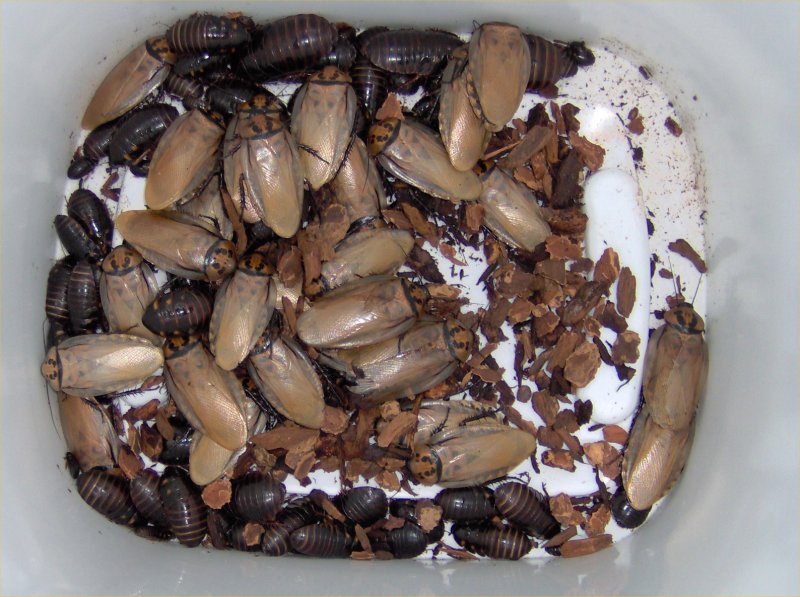
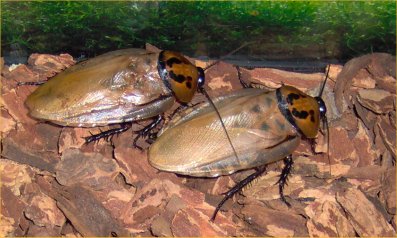
On 2/16/06, I got roaches for my lizard, Einstein. I got 40 full adult Eublaberus distanti or the six spotted roach which grow 1.5 to 2 inches long. I also got about a dozen Eublaberus prosticus of various ages which also grow to 1.5 to 2 inches although the ones I got were smaller. They are also called orange head roaches. I put two E. prosticus in my lizard's tank when I got them. She ate one. The other one ate her fruit and then moved in to her log. The next morning, I put in one of the huge E. distanti. Einy tried to eat it and even licked it for a moment but it was too fast. Einy eyed the roach as it cruised around her home. I did not know how long they would stay buddies. Well, when I came home from work, her new friend was drowned in Einy's pool. I put the body next to Einy. In honor of her best friend, she ate his body.
Orange head roaches are a bit more prone to eating the wings off of each other and eating vulnerable invertebrates than some other species. Both the species that I had do not fly or climb.
Einstein was still egg bound as of 3/10/06 and not eating. A vet visit did not fix her problem. So, she was not eating all those roaches. On 3/8/06, when cleaning the roach's food dish, I almost threw out a little bug until I realized it was my first baby roach! He was about 4 mm long.
As of 6/9/06, Einstein had not eaten any more roaches! I put the orange head roaches in with her. They even crawled on her, and she ignored them! Einstein had laid her eggs but she did not want roaches! The six spotted roaches had a ton of babies but when I cleaned the cage out on 6/3/06, I found a lot of dead ones. I think the babies could not get to the food and water easily enough so I moved them to their own small cage. Of course, I did not know what I was going to do with all these roaches! When the baby roaches would become larger, my small turtle could eat them but he could not eat the adults.
The ants found the roach tank in late June, 2006. There were hundreds of ants all over the roaches' food. I tried everything. On 7/6/06, I added a green anole (read about Fourmi the anole) to hopefully eat some ants. It did not worke. The roaches and anole got along fine and ignored each other.
Update 1/22/07: Fourmi was still doing great with the roaches. The 40 six spotted roaches were now down to 14. Only one was eaten by Einstein. The rest have mostly died from old age (and a few that drowned in Fourmi's water). There were also about 7 adolescent six spotted roaches in there that I moved from the unheated baby tank. The adults had stopped reproducing (they were too old) but I had a few hundred of their babies that were kept stunted (because there was no heat) in a two gallon cage. I felt bad about that but what do I do with them all since none of my animals will eat them? One person expressed concern that the roaches would harm my anole but he was perfectly fine. They got along great and did not bother each other. Fourmi might have eaten some of their babies although I have not seen that.
[Note: I put the above in the past tense on 10/23/13 but I am leaving the following in present tense for now even though it is also in the past.]
On 3/3/07, there were only three of the orange headed roaches left in a three gallon plastic cage. They had not done well because, unlike the six spotted roaches, they did not have heat. I decided to put these last three into my sailfin lizard's cage. Einstein looked interested but did not eat them. There is one adult who was running all over the cage like crazy, probably ecstatic to have heat, and two juveniles. They will either do better (good for them), or Einstein will eat them (good for her). If I had left them in the cage, they would not have lived much longer. The remaining six spotted roaches seem fine. Some of the babies I got are now getting almost as big as the parents but still have juvenile coloration. By 3/10/07, when I cleaned out Einy's tank, I only found one of the orange headed roaches left, and it could not walk despite appearing physically okay. I assume the other two were eaten. So, NOW Einy wants to eat some!
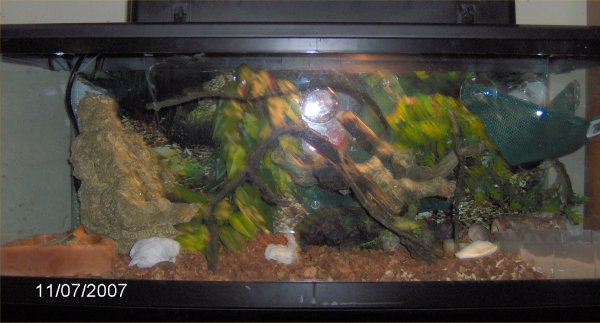
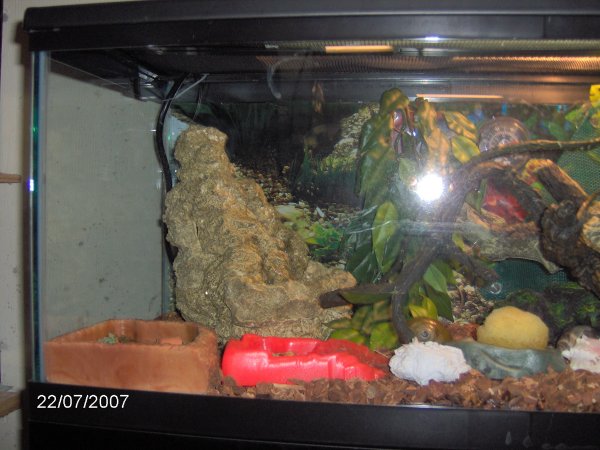
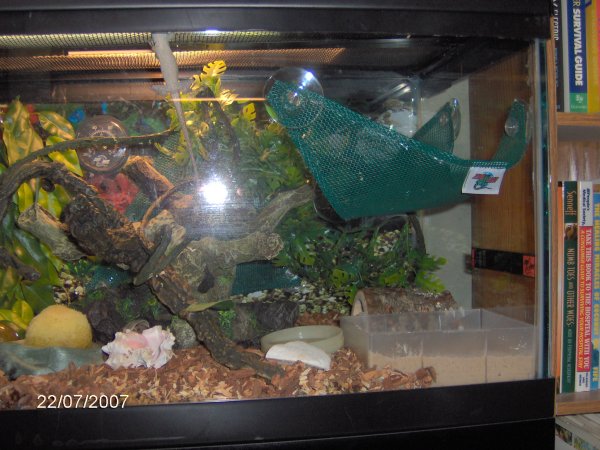
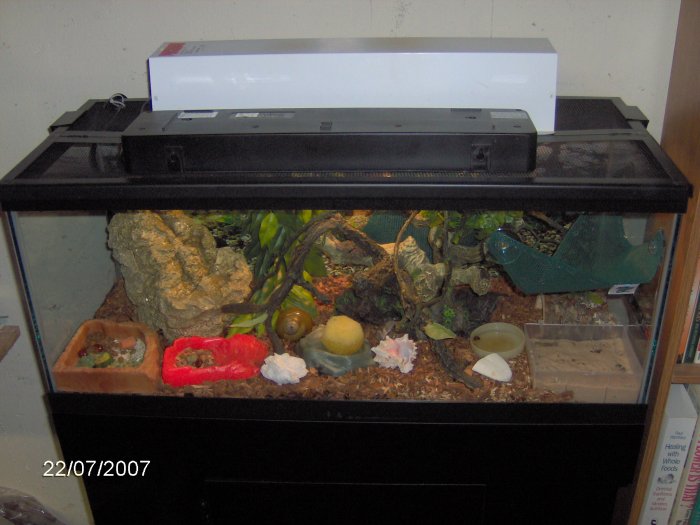
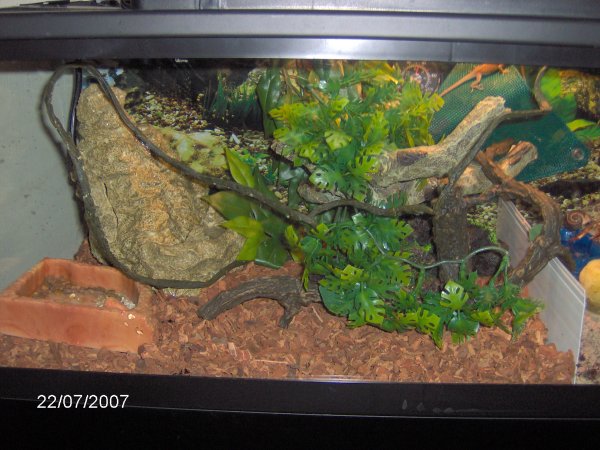
On 4/11/07, I moved my roaches and anole to a 20 gallon tank which is set up more naturally (and more for the anole). I counted the roaches. There are only 6 adults, 11 sub-adults, and 103 baby (from a two gallon plastic container they were in) six-spotted roaches left. You can read about the tank renovation and see a photo of the set up tank on my tank redo page.
When I cleaned out their cage on 5/28/07, there was only 1 live adult, 11 sub-adults, and just 6 babies! I do not know if the adult roaches, the anoles, or even the crickets ate the babies. Some dead adults were found but no dead babies.
A week later, that last original adult died. As of 6/28/07, I rarely see roaches in the tank except some of the sub-adults hide under the food dish.
On 7/8/07, my mother got a hermit crab who joined the other animals in the 20 gallon tank. The anoles and roaches get along fine. The roaches stay hidden in the substrate.
When I cleaned out the cage on 7/22/07, there were 11 sub-adults and 3 smaller ones. Half of the smaller ones died but the others are doing well.
When I cleaned out the tank on 9/16/07, there were 7 adults, 5 sub-adults, and 2 small ones. That means that none have died. Seven of the sub-adults molted into the final adult pattern. Soon, I may have to deal with babies again.
When I cleaned the cage on 11/11/07, there were 11 adults and 3 sub-adults left. None have died.
When I cleaned the cage on 1/6/08, there were 11 adults, 3 sub-adults, and 13 babies! So, none have died and now this next generation is breeding. I am a great-grandroach!
I cleaned the cage on 3/2/08 and found 12 adults, 2 sub-adults, and about 10 babies (they did not sit still to count!). So, none of the adults had died. One of them escaped behind the washing machine (first ever escape) but he was on the floor in the morning about three days later, and I put him back in to the tank. He was lethargic; I do not know if he will recover as he is still lethargic a week later. He looked okay but my kitten may have beat him up.
When I cleaned the tank on 4/22/08, I found 12 adults, 1 sub-adult, and about 20 babies of all sizes (too many to bother counting). Only the previously mentioned single adult roach has died among the larger ones.
When I cleaned out the tank on 6/22/08, there were 13 adults (so none lost) and at least 13 others. I did not count them all. When I cleaned it on 8/12/08, there were still 13 adults and about 20 sub-adults, juveniles, and babies.
I cleaned the tank on 10/13/08. There were 17 adults, 16 sub-adults, and 6 baby roaches.
When I cleaned the tank on 11/27/08, I found 18 adults, 14 sub-adults, and 22 babies! I did not find any bodies so one sub-adult vanished? The other, of course, became an adult. One of the adults was white as it had just molted so that was probably the one sub-adult that changed. One of the adult's was barely response, and I think it died in a few days.
On 12/27/08, there were two adult roaches on the surface that were dead with no injuries. I do not know if they were old or something else happened to them.
When I cleaned the tank on 1/25/09, I found 21 adults, 11 sub-adults, 9 babies, and 1 dead adult roach. So, there were 13 fewer roaches than last time. It seems only three of the previous babies made it to sub-adult.
I cleaned out the tank on 3/22/09 and found 22 adults, 4 sub-adults, 6 larger babies, and one smaller baby (not newborn). There were no newborns. I removed a few dead adults within the last few weeks. There were eight fewer roaches than last time. The oldest adults are dying of old age.
When I cleaned the tank on 5/13/09, I found 22 adults, 10 sub-adults, and 4 babies. When I cleaned the tank on 7/12/09, I found 20 adults, 11 sub-adults, 1 baby, and 1 dead adult. I had removed another dead adult the month before. On cleaning the tank on 9/7/09, there were 20 adults, 10 juveniles, and 3 babies. A tank cleaning on 11/8/09 (a week late) yielded 2 squished dead adults, 21 live adults, 7 juveniles, and 19 babies!
I cleaned the tank on 1/17/10 about two weeks late (recovering from surgery). There were 25 adults, 18 juveniles (most of them small), 10 babies, 1 white newborn, and one squished adult.
I cleaned the tank on 3/21/10 and found 25 adults, 16 juveniles, 9 babies, 9 newborns, and one dead adult. I have removed another dead adult a few weeks earlier. I cleaned the tank on 5/22/10 and found 24 adults, 19 juveniles, and 5 babies. A few adults died in the last few months.
I cleaned the tank on 7/25/10 and found two squished adults, 26 adults, 15 juveniles, 62 little ones, 13 newborns in the tank, and about 20 more I had gotten from the food dish the week before. That is a total of 136 roaches, a new record! What am I going to do with all of them! I keep waiting for the reproduction to stop!
The tank was cleaned on 9/11/10. I found four dead adults, 29 live adults, 18 juveniles, 50 little ones, and 43 newborns for an even bigger record of 140 individuals.
I cleaned the tank on 11/14/10 and found two dead adults, 30 live adults, 64 juveniles (a record for that group!), 26 babies, and 13 newborns for a total of 133.
I cleaned the tank on 1/6/11 and found 29 live adults, 63 juveniles, and 29 babies ranging from slightly post newborn size up to juvenile size for a total of 121. Some of the babies did not make it from last time.
I cleaned the tank on 3/20/11 and found 31 live adults, 2 dead adults, 1 squished juvenile, 74 live juveniles, 7 babies, and 24 newborns for a total of 136! The newborns are hard to collect because they play dead when touched and blend in with the Repti-bark.
I cleaned the tank on 5/11/11. I found 53 adults, 50 juveniles, 11 babies, and 10 newborns. There was one squished sub-adult (juvenile). There are so many adults now, more than ever!
I cleaned the tank on 7/4/11. I found 1 dead adult, 71 live adults (a record!!), 31 juveniles, 15 babies, and 20 newborns. This is the most roaches I have ever had.
I cleaned the tank on 9/4/11. I found 84 adults, 29 juveniles, 11 babies, and put 29 newborns in the main tank. I stopped sorting the Repti-bark for newborns once I realized that there were hundreds of them. I put the litter in a two gallon plastic "tank." I have no idea what I am going to do with all these roaches! I hate to give them away because I know they will be killed but this is out of control. The adults were even doing mating dances while I was trying to clean!
I came up with a new plan. On 10/22/11, I sorted the cage with the babies, thinking most would be dead. Well, they were all in the bottom inch of substrate, a few hundred of them! I cannot see myself continuing to care for roaches until my last day. I do not want to kill any of them but I have exhausted other options. The zoo (that has roaches of other species) will not take them. Anybody else that would take them would feed them to their animals. Instead of getting yet another animal, some lizard, to go in the big cage and maybe eat some of the babies, I am going to feed the babies to my chickens. I feel really bad for the little baby roaches but, if I can feed mealworms to the chickens, why not roaches. My youngest chicken, Petunia, is the only one who has eaten them the first few days I have tried. The rooster, Speckles, just drops them. The other two girls are scared of them. When I clean the tank each time, I plan to put the babies (1.5 cm or smaller) in the other container and give them to Petunia. In a few years, there should therefore be no more roaches.
I cleaned the tank on 10/30/11. I found 88 adults, 38 juveniles, and 163 newborns! I put the newborns in the separate cage to feed to the chickens. The chickens ate the last newborns on 12/3/11 (until the next cleaning anyway).
I cleaned the tank on 1/1/12. I transferred all of my files to a brand new flash drive later that day and updated this page with the number of roaches that I counted only on the new flash drive. Said new flash drive stopped lighting on 1/6/12 such that I could no longer access any of those files. I tried 50 some times to get that new flash drive to work. I had to use the earlier version of this page to move forward instead. Since my father recycled the paper with the roach counts on 1/6/12, I have no idea how many roaches I counted. My memory for that sort of stuff is near zero. I do know that there were 90 some adults, maybe 20 some juveniles (only two were on the smaller size), and perhaps 60 some babies. There were also a thousand ants living in the tank (what a mess!). Even though I removed all the bedding and ants, somehow on 1/7/12, when I cleaned their bowls, they were full of hundreds of ants again! I see no evidence of them going in and out of the tank.
On 2/4/12, I removed three dead roaches (and another a few days earlier). On Saturdays, when I change the fountain water, I have been spraying orange air freshener (all natural) on the hoards of ants in there. I did not think the spray would harm the roaches. It kills ants when sprayed on them. Apparently, a few roaches got enough on them to die as well. I did not want to harm them. Ants are impossible to get rid of in this situation. I would not mind if they did not swarm all over my hands when I pick up the food dish and water fountain to clean them. I guess I cannot spray in the tank even though I thought the spray was only directed at the ant hoard.
I cleaned the tank on 2/28/12. I found 99 adults, 3 dead adults, 18 large juveniles, 2 smaller juveniles, and 17 newborns (which the chickens ate). That means there are 119 roaches in the tank. This is the most adults ever. I am hoping that, with the removal of the newborns, the numbers will start to go down when the adults are old enough to die of old age. I have four times more roaches now than I did two years ago.
I cleaned the tank on 4/24/12. I found 104 adults, 6 dead adults, 10 juveniles, and 153 newborns! I put the newborns in another tank to slowly feed out to the chickens. So many babies!!
I cleaned the tank on 6/20/12. There were 109 adults, 3 dead adults, 4 juveniles, and 64 newborns.
I cleaned the tank on 8/15/12. There were 113 adults, 3 dead adults, 2 juveniles, and too many newborns to count (over 100). Based on previous counts, the juveniles must have been newborns that survived. I just put the Reptibark in another container with all the babies to sort later.
I removed a few (maybe four) dead adults over the next few months. When I cleaned the tank on 10/4/12, there were only 3 dead adults, 94 live adults, 2 juveniles, and ~81 newborns. I went down 19 roaches! Yeah! Some of the remainder are looking bedraggled.
I cleaned out the roach tank on 11/27/12. There were 83 adults, 4 dead adults (a few removed in the previous weeks too), 2 juveniles, and, get this, 0 newborns. That is right, no babies! So, that either means that they are all too old now to procreate, or the conditions were somehow bad even though I have always found babies in every cleaning for years! With 85 total roaches, this is the lowest the population has been in three years. Many of the surviving roaches seemed unusually slow and weak. I think most will be gone in a year before I am too weak and old to care for them.
I cleaned the tank on 1/17/13. There were only 54 adults, 3 dead adults (but I have removed some every week since the last cleaning), 2 juveniles, and 13 babies. I put the babies back in the tank (more out of laziness than anything). Any surviving babies will be chicken food with the next cleaning because I cannot be caring for these roaches to my dying day. I am finally making progress and reducing the colony. Eventually (when all adults are beyond breeding age), it will collapse.
The tank was cleaned on 3/18/13. The colony has collapsed to only 36 adults. There were three larger babies (almost juvenile) and six smaller babies. I thought the chickens might have trouble eating them but they were gone so fast that sad regret at their passing was fast. Part of me will really miss the roaches when they are all gone.
I cleaned the tank on 5/17/13. There were two dead adults, 32 live adults, and one baby that I lost. I cleaned the tank on 7/18/13. I found 26 live adults and 3 dead adults. There were no juveniles or babies. I think the colony is now no longer self-sustaining. It is sad but necessary.
I cleaned the tank on 9/9/13. There were only 14 live adult roaches left. When I cleaned the tank on 11/1/13, there were 7 live adults and 2 dead. I have been removing dead ones between cleanings when I see them as well. The end is near.
When I cleaned out their food dish on 11/9/13, I found a roach egg case in it! I put it in another container but I guess they are still breeding.
I cleaned the tank on 12/31/13. There were 3 live roaches and 2 dead roaches. When I cleaned the tank on 2/13/14 (snowed in), I found 2 live roaches. They are the last two, best buddies. I cleaned the tank on 4/17/14, and the two roaches were still alive. I cleaned the tank on 6/14/14, and both were alive but one seemed half dead. I saw both roaches on 7/19/14.
I cleaned the tank on 9/1/14, and the two roaches were still there.
I found a dead roach the morning of 10/27/14 which leaves just one left. I was suprised to find him/her dead the next morning. I am glad that they died within a day of each other so one did not have to live alone. I cannot believe the era of the roaches has ended. It took three years for the adults to die off after I started feeding the newborns to the chickens. I may have missed a baby or two here or there though so the last two probably were closer to two years old and not three years old.
Photos are listed from oldest to newest.
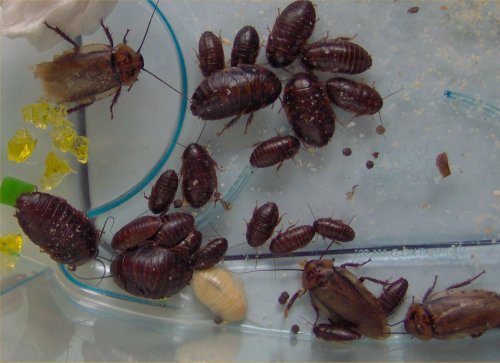
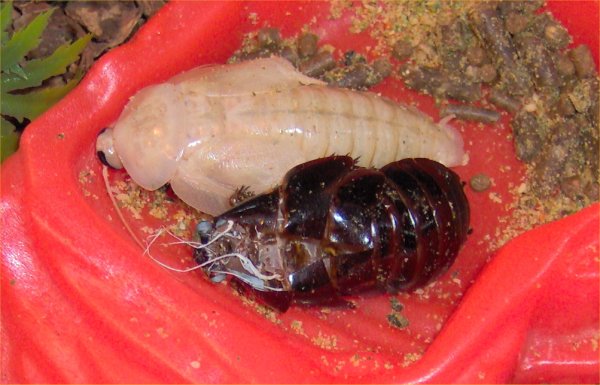
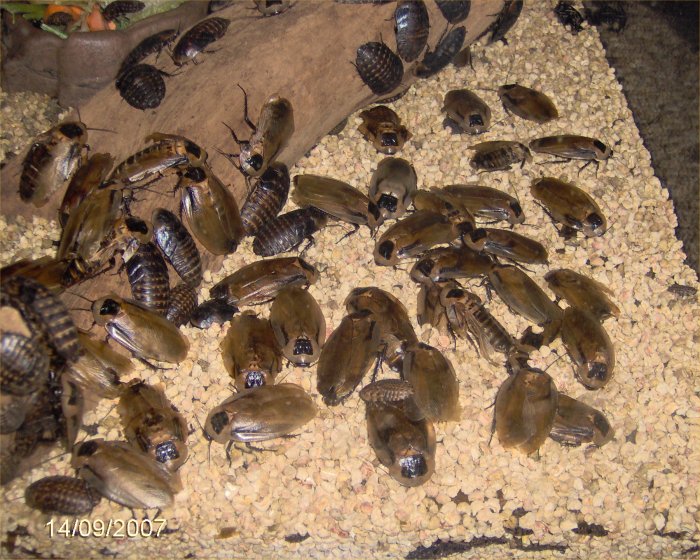
A bunch of E. prosticus of
various ages. There is one that just molted so it is white. There are three orange-headed adults
and many nymphs. The photo was taken on 2/18/06.
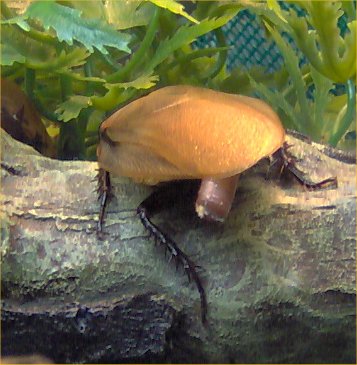
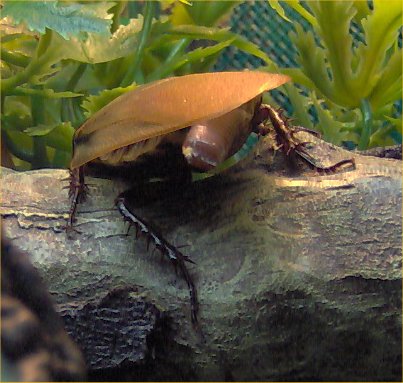
Two E. distanti on
2/18/06.
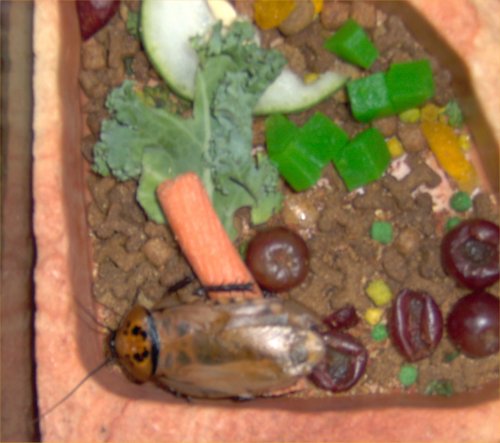
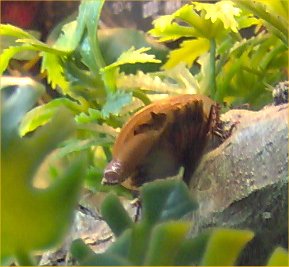
One E. distanti in the food dish
on 2/18/06.
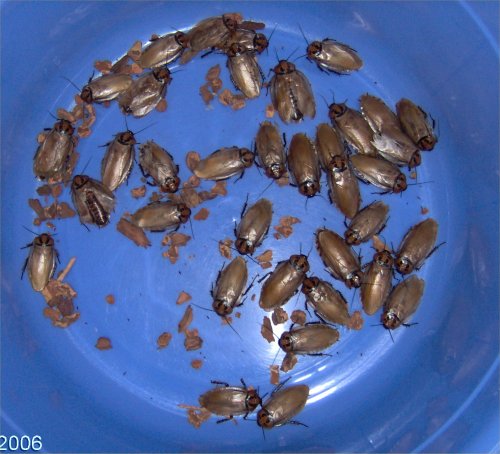
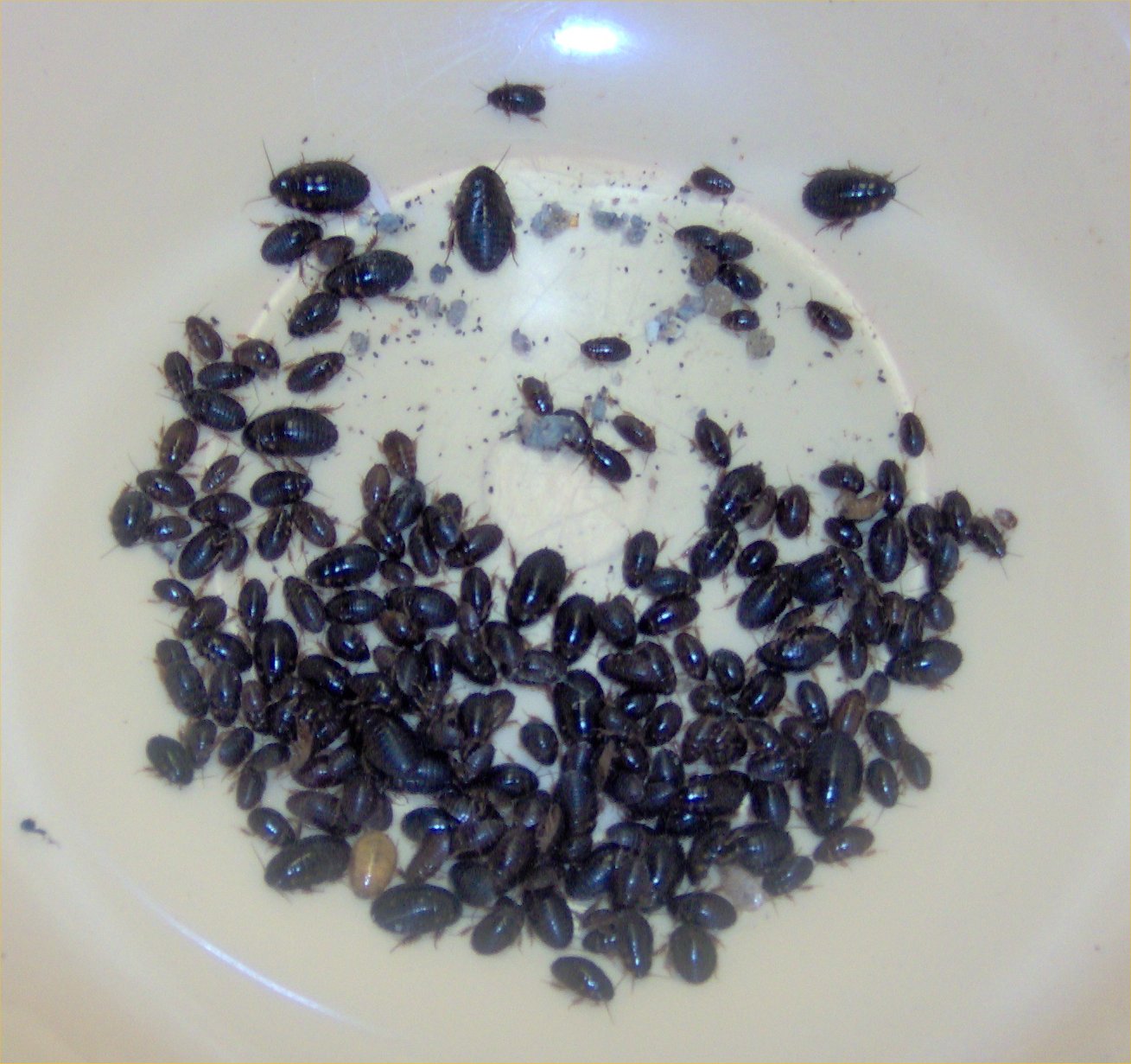
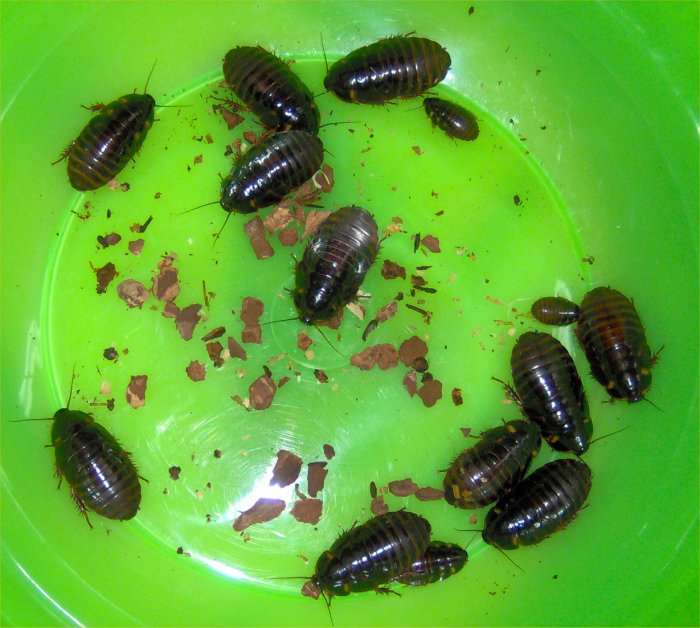
On 6/3/06, I cleaned out the big roach tank. Here are two photos of them in a holding bowl.
My 38? adult E. distanti
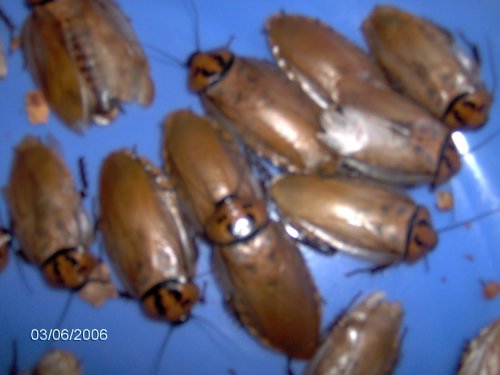
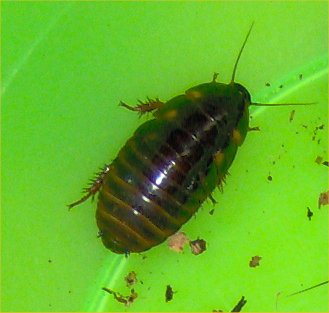
A close up of the same E.
distanti
I took this photo of the many baby roaches I now have on 11/18/06. These are baby E.
distanti.
There are tons of them. Can you count them for me?
Baby roaches
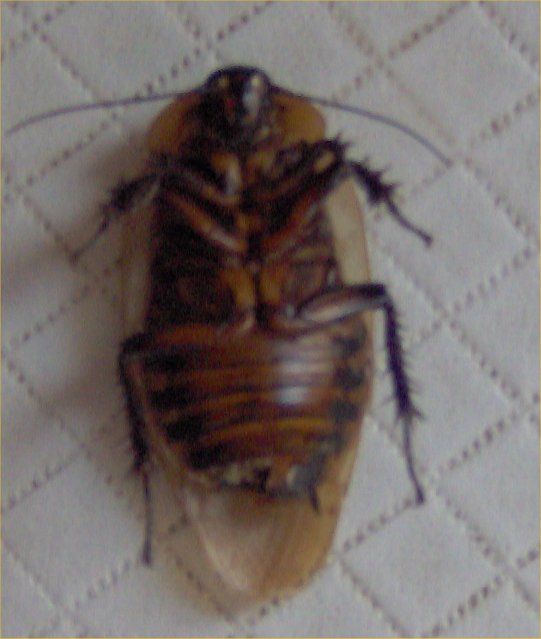
Underside of dead six-spotted roach - 4/7/07. Somebody bit off a part of his rear.
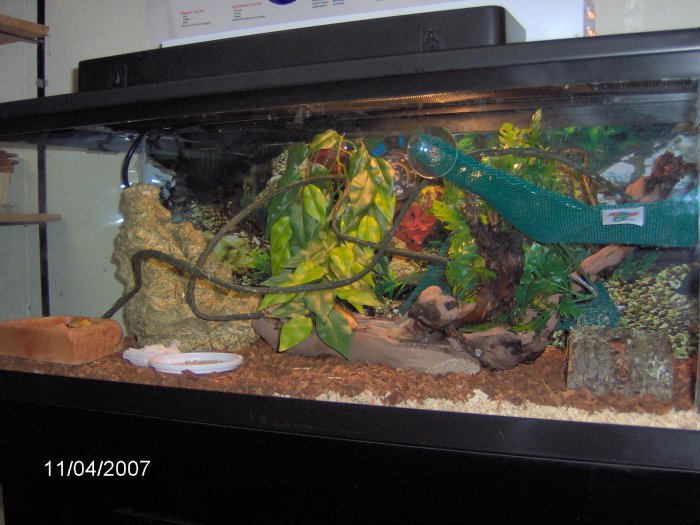
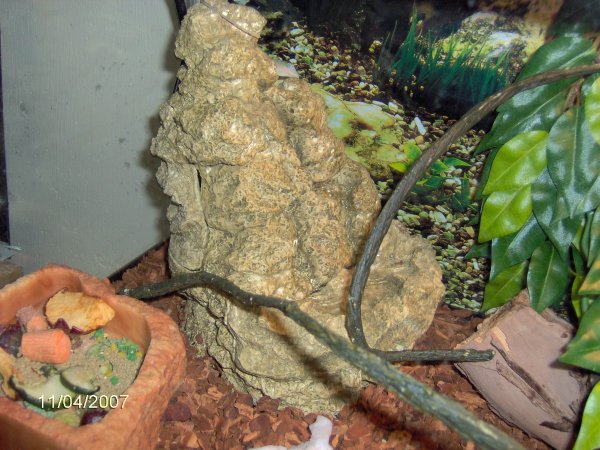
I moved the roaches to a 20 gallon tank on 4/11/07. You can read more about that on the tank redo page. Here are photos from that day.
20 Gallon Tank
Waterfall
20 gallon tank on 7/11/07. The photos is out of focus but shows the tank.
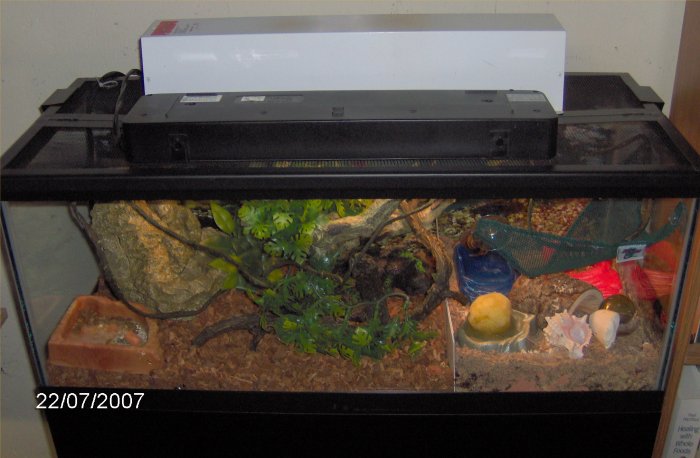
On 7/22/07, I took these photos of the 20 gallon tank before and after I cleaned it and set up a
hermit crab section.
----------
Before Photos:
The left side of the 20 gallon tank - includes
the waterfall.
The right side of the 20 gallon tank -
includes Herman's box of sand and Fourmi (the anole) clinging to the glass at the top
Entire 20 gallon tank
----------
During Cleaning:
Roaches - 11 sub-adults and three smaller
ones.
Sub-adult roach - close-up from last
photo.
----------
After Photos:
20 gallon tank - with new hermit crab
section on the right.
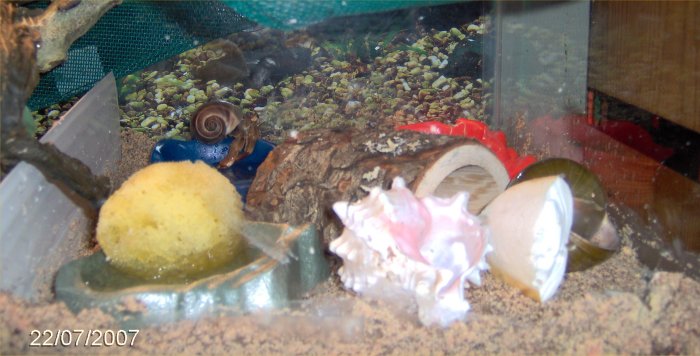
The right side of the 20 gallon tank - the
hermit crab section. Herman can be seen in the back of the photo.
The left side of the 20 gallon tank - on the
right at the top, one of the anoles can be seen; on the right at the bottom is Herman.
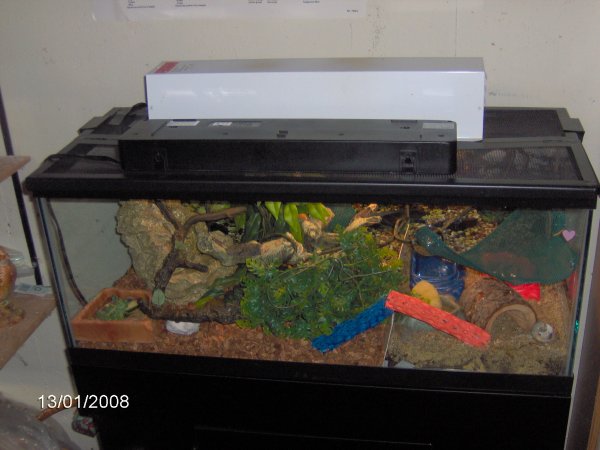
Here is a photo of the 20 gallon tank from 1/13/08.
20 gallon tank
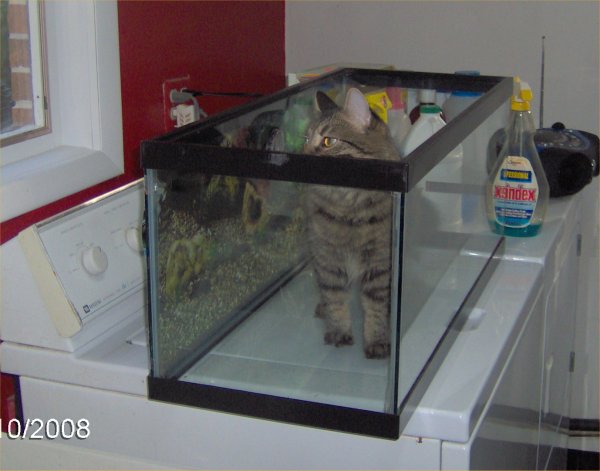
Tinkie my cat on 10/14/08 inside the 20 gallon glass aquarium that I was cleaning. It is the roach tank but Tinkie thought it was for her! She also jumped in several times while the tank still contained roaches and Repti-Bark!
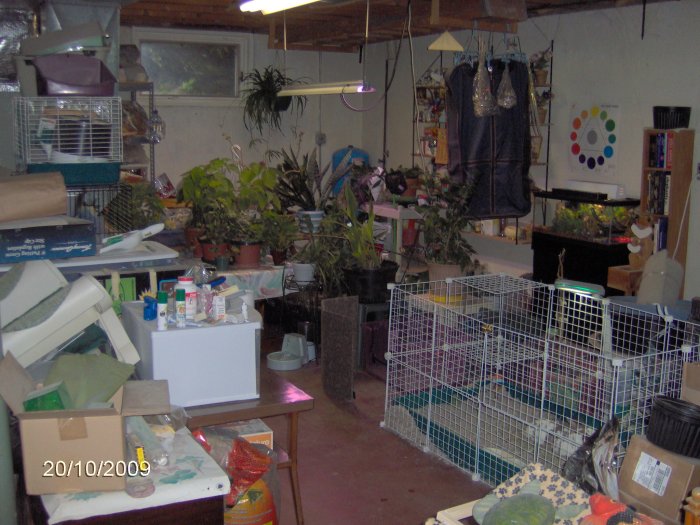
Basement on 10/20/09. You can see the 20 gallon tank from a distance. I was taking photos of the basement pond and plants I brought indoors for the winter.
Newly adult roach - when they first shed their juvenile exoskeleton, they are white like this guy on 11/15/09. They soon turn dark.
For the first time, I saw a female laying her egg case on 10/10/10. They are "live bearers" which,
in this case, means that as soon as that case hits the ground, the little roaches start popping out of
it, all ready for the world. Here are photos.
Female roach birthing
Female roach birthing
Female roach birthing
133 roaches waiting in the cat litter bucket
during the tank cleaning on 11/14/10.
Roaches - 1063 KB, mpg movie. Video of those same
roaches from 11/14/10. My cat, Barney, can be seen at the end. He was watching them too.
When I cleaned out the roach's food dish on 11/9/13, I found this. It is a roach egg, just laid!
The
babies never came out. The egg should break open soon after being laid as this species is
considered
a live-birthing roach.
Roach egg
Roach egg
This is the book that I have which is not sold at amazon (I checked):
Allpet Roaches by McMonigle and Willis, Elytra & Antenna, 2000, ISBN 0-
9719129-1-2.
I ordered my roaches and the above book from this site which I highly recommend. They also
have care sheets and tons of information. They have a large selection of roach species:
Blaberus.com
Here are some other sites that sell roaches and have information.
Big Apple Herpetological - sell a number of
species of roach
Allpet Roaches
Ronald's Roaches - sold a few species but this is an archived version of the site that no
longer exists.
Tropical Roaches as Pets - information
Cockroach Facts
Here are some roach photos from the National Zoo that I took on
9/14/07:
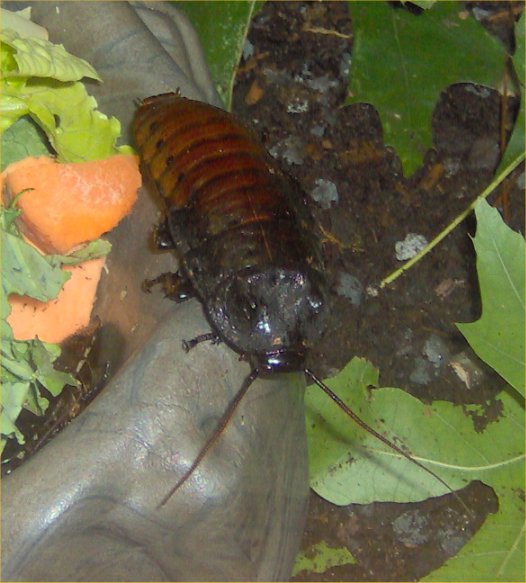
Madagascar hissing
cockroach
A colony of roaches - I forgot to
write down the species name but it was not one I have had before.
1
|
|
Return to the main insect page.
See the master index for the insect pages.

|

|
E-mail RobynCopyright © 1997-2026 Robyn Rhudy |

|
 |